
Airspace management consulting service: Why dynamic airspace is essential for integrating new entrants into aviation
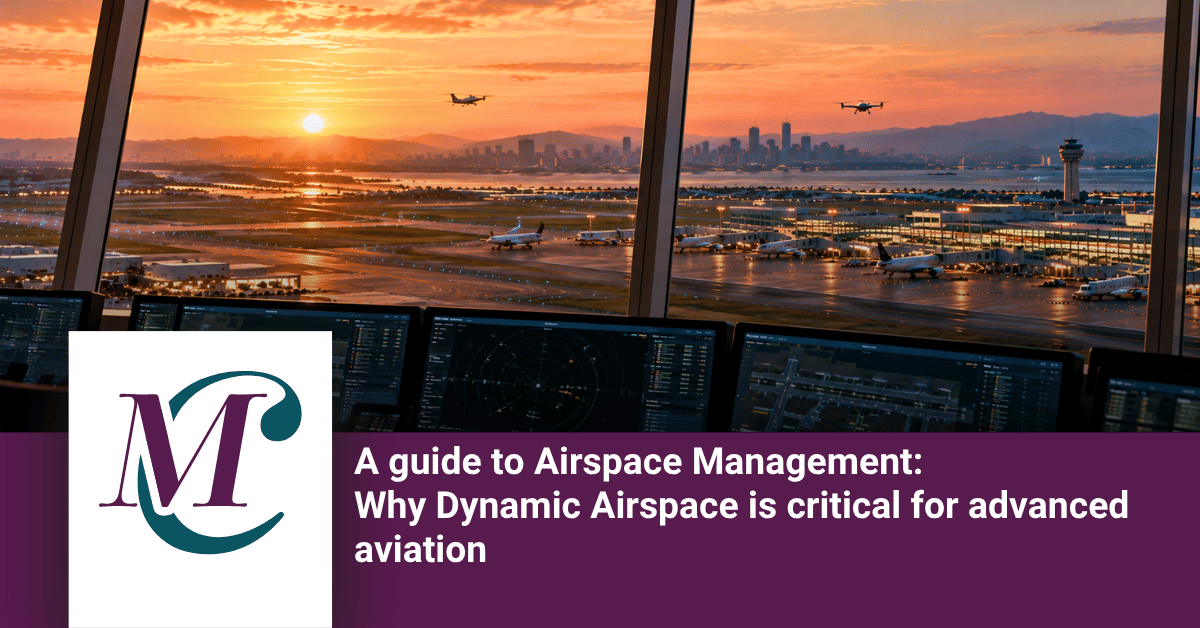
Airspace design and management services are becoming one of the most important enablers for faster integration of advanced aviation, as it shares increasingly restricted airspace with commercial aviation, military operations, and, more generally, crewed aviation, and other more traditional uses of airspace.
The market outlook supports this direction. MarketsandMarketsestimates that the global air traffic management market will grow from USD 12.20 billion in 2025 to USD 15.20 billion by 2030, at a compound annual growth rate (CAGR) of 4.5%, driven by rising traffic, airspace congestion, modernisation programmes and digital technologies. The report also identifies Europe as the fastest-growing region, supported by regulatory initiatives, airspace modernisation, the Single European Sky initiative, digitalisation, automation and cross-border airspace integration.
This article explains the fundamentals of airspace management, why the industry is moving from static structures to dynamic airspace management, and how Murzilli Consulting supports air navigation service providers (ANSPs), aviation authorities, operators, and service providers through airspace analysis and improvement proposals, air risk management, modernisation, technology implementation, U-space consulting, and certification.
Expert insights are provided by Rafael Pecos Macías, Deputy Director of Murzilli Consulting in Spain, and Andrés Felipe Calderón Valverde, Senior Consultant for Airspace.
Rafael contributes more than two and a half decades of experience across ENAIRE, International Civil Aviation Organization (ICAO), European Organisation for the Safety of Air Navigation (EUROCONTROL), spanning non-standard operations, low and medium-height unmanned aircraft systems (UAS), higher-altitude platform systems (HAPS), airspace design and flight procedure design, as well as the development of operational procedures and regulations.
Felipe is an aeronautical engineer with expertise in flight procedure design (FPD), software development, and certification processes for FPD providers.He supports existing and prospectiveFPD providers to develop, validate, or certify flight procedure design capabilities.
Why has airspace management become a strategic priority?
Historically, the airspace system was designed around conventional crewed aviation, predictable traffic flows, fixed procedures, and established coordination among airlines, general aviation, ANSPs, military users, and regulators. This model is now being challenged as the same airspace must also support uncrewed aviation, including UAS at very low and medium heights, HAPS, and urban air mobility (UAM), including electric vertical take-off and landing (eVTOL) aircraft, along with their associated business models and the advanced air mobility ecosystem itself.
The pressure on European airspace is already measurable. EUROCONTROL’s Performance Review Report 2025 recorded 11.1 million controlled flights in the EUROCONTROL area, representinga 4.3% increase compared with 2024 and slightly above 2019 levels. At the same time, available controlled airspace remained around 6% smaller than in 2019,primarily due to the closure of Ukrainian airspace following Russia’s invasion in 2022, showing why airspace capacity, coordination and dynamic airspace management are becoming strategic priorities.
For companies entering this environment, airspace management has become a critical business capability, rather than a purely technical or regulatory issue. It can determine the viability of a drone strategy, the scalability of beyond visual line of sight (BVLOS) operations, the feasibility of deployment in U-space, the decision to establish a HAPS base of operations in a specific location, and the potential for advanced aviation projects to move from the conceptual to the operational phase and even become established.
As Rafael explains, "Aviation regulation has now shifted toward facilitating large-scale integration, not just in terms of regulatory compliance", a change that forms the basis of modern airspace management.
What is airspace management?
Airspace management is the process of organising, allocating, and coordinating the use of airspace so that different users can operate safely, efficiently, equitably, and predictably. It determines who can use a specific volume of airspace, when, at what altitude, under what restrictions, and with what coordination requirements. This management is considered holistically, encompassing the strategic, pre-tactical, tactical, and post-tactical phases.
For crewed aviation, this has long supported traffic flow, route availability, control sector capacity, and reserves for military and civilian activities, ensuring safe separation between different airspace users. Above all, airspace management has minimised the impact on commercial aviation.
For uncrewed aviation, the challenge is more complex. BVLOS drone flights, their flight performance, autonomy, connected aircraft technology, the implementation of Remote Identification (Remote ID), Unmanned Aircraft System Traffic Management (UTM), and its services depend on an airspace environment that can safely absorb these new types of traffic.
This is where specific drone and UTM regulations, national coordination and operational procedures, Specific Operations Risk Assessment (SORA) methodology, and cybersecurity connect directly with airspace management. According to Rafael, many UAS and advanced air mobility (AAM) companies, including higher airspace operations (HAO), have robust technology, often lack the aeronautical regulatory expertise and operational structure needed to manage complex approvals or to coordinate effectively with key authorities. This is especially true regarding the specific processes of each country, authority, and/or national ANSP, and the time required to complete them. In some cases, these processes may conflict with commercial commitments made to clients.
Murzilli Consulting therefore provides end-to-end support toboth traditional and advanced aviation organisations including strategy, regulations, authority engagement,technology, and policy.
Why is the industry moving from static to Dynamic Airspace Management?
Traditional airspace management relied on fixed structures and static civil-military segregation, with certain areas reserved, restricted, or avoided according to predefined plans. This approach worked when traffic volume and patterns were more stable, and the diversity of airspace users was lower than today. While this has evolved in recent years in various regions of the world thanks to concepts like Flexible Use ofAirspace (FUA), advanced aviation now requires a more adaptable and agile model.
Dynamic Airspace Management allows airspace to be allocated, released, configured, and reconfigured based on expected operational demand, safety requirements, mission needs, and real-time or near-real-time data. By connecting Dynamic Airspace Configuration, Dynamic Mobile Areas, Demand-Capacity Balancing, and Collaborative Decision-Making, airspace becomes a much more efficient and flexible operational resource.
For operators of UAS, eVTOL, and HAPS, this can make the difference between theoretical innovation in aviation and actual operational scalability, especially where advanced air mobility corridors and drone delivery business models cannot scale if every operation is treated as an exception.
What is the hidden challenge behind airspace scarcity?
It's important to note that airspace scarcity doesn't always refer to physical space. It can stem from a lack of operational solutions, technological solutions, regulatory development, or a combination thereof.
Rafael explains that this primarily affects commercial aviation, and by extension, uncrewed aviation. This is particularly evident in Central Europe and other regions of the world, and is becoming increasingly apparent in the terminal manoeuvring area (TMA) around major international airports. It also creates a ripple effect on low- and medium-altitude UAS operations, which must be coordinated by air traffic service providers in already congested controlled airspace. For UAS operators, the problem often lies less in airspace availability and more in the capacity of air traffic services to manage demand.
EUROCONTROL’s 2025 data also shows that capacity pressure is not evenly distributed. The five most penalising area control centres (ACCs) generated 47.1% of total en-route air traffic flow management (ATFM) delay in 2025, despite accounting for only 13.2% of controlled flight hours. This supports Rafael’s point that the challenge is not always physical airspace availability, but the capacity of the air traffic management (ATM) system to manage demand where it is most concentrated.
For operators, authorities, and service providers, the challenge typically manifests in four ways:
-
Limited coordination capacity: The airspace may exist, but the system may still lack the processes, staffing capacity, or digital tools necessary to integrate new users on a large scale.
-
Lengthy approval times: Companies often underestimate the time it can take to go from a promising drone business idea to an approved operation.
-
Novel operations without mature procedures: New UAS, HAPS, or complex uncrewed use cases may not be fully covered by existing regulations, which can prolong their assessment, coordination, and operational authorisations before they can be flown.
-
The need for an early Concept of Operations (ConOps): A robust drone strategy, fully connected with an airspace utilisation strategy, should begin with a regulatory and operational feasibility study, coordination with authorities, and an analysis of risks and potential mitigations. The starting point for all of this is a clear definition of the operational concept to be implemented.
Therefore, putting a drone business idea into practice can be a long and complex process when the operation is novel or not fully covered by existing regulations or procedures. The main obstacle is usually the time required to assess legal compliance, obtain authorisations, and safely integrate the operation into the current use of airspace. Some coordination and processing times may exceed one year, especially when the operation is new, complex, or has not yet been considered previously by the competent authorities.
This is where Murzilli Consulting makes a difference in the sector, as it has extensive experience in innovative, large-scale international operations, and professionals from Operators, Authorities, and ANSPs who have participated in the design, definition, and execution of operational improvements, tools, and specific regulations.
Why is air risk becoming more complex?
The integration of uncrewed aviation is altering the risk profile of the airspace system. Low-altitude airspace is becoming more active with small and medium-sized UAS operations, including business models for policing, emergency services, public agencies, infrastructure inspection, and drone delivery. At the same time, airspace above flight level 500 (FL500) is attracting HAPS, including stratospheric balloon operations.
Rafael has observed increased complexity in low-altitude airspace during his work supporting the integration of UAS and HAPS, particularly in Spain, which representsa significant number of routine BVLOS drone operations worldwide.
This complexity stems from several interrelated factors:
-
Greater diversity of aircraft types: Crewed aircraft, low and medium-height UAS, HAPS, and future eVTOLs exhibit different performance profiles, operating altitudes, and contingency behaviours.
-
More demanding environments: Controlled airspace, especially terminal areas and control zones (CTRs), restricted zones, and low-altitude corridors, require precise coordination among UAS operators, ANSPs, authorities, general aviation users, sport aviation, police and emergency air services, and military stakeholders.
-
Greater reliance on digital systems: Cybersecurity, remote identification, UTM and pre-UTM services, drone autonomy, communications quality, and connected aircraft technology are now part of the operational risk landscape.
-
More complex safety scenarios: The SORA methodology provides a secure integration framework, but advanced uncrewed operations often require a deeper understanding of airspace, procedures, and the competent authority. This is even more crucial when scaling up these operations.
Airborne risk identification and management addresses these issues through risk assessments, collision probability analysis, assessment of adjacent airspace, mitigation strategies, flight authorisations, and coordination with civil and military stakeholders. The Murzilli Team applies SORA and also contributes regulatory, procedural, airspace, and competent authority knowledge in cases where the methodology alone is insufficient. Murzilli Consulting proposes safe integration strategies going beyond the current SORA framework, working collaboratively with authorities to develop the sector and help expand use cases and business models.
For UAS operators conducting "complex" operations, this is often crucial. Risk analysis and mitigation are not just a requirement for obtaining operating authorisations. They determine whether the route, altitude, contingency plan, communications architecture, and operational assumptions are acceptable for practical implementation.
Why does airspace digitalisation depend on trusted data?
Dynamic airspace management relies on data, but not all data can be used in the same way. Connected aircraft technology, real-time telemetry, application programming interface (API)-based services, Remote Identification (RID), Electronic Conspicuity, System Wide Information Management (SWIM), meteorological data, and UTM platforms can all improve situational awareness.
However, as these systems become less dependent on human decision-making, safety- and efficiency-critical decisions must rely increasingly on verified and standardised aeronautical data.
Rafael's position is clear: certified or official data, such as that defined by ICAO, national Aeronautical Information Publications (AIPs), meteorological information from official sources, or data from communication, navigation and surveillance (CNS) and ATM systems, is the only verified, consistent, and reliable information on which to base operational decisions. The remaining information, although it may be very useful, must be verified and processed before being integrated into decision-making.
Murzilli Consulting helps clients recognise and connect to reliable official sources of aeronautical, meteorological, and other data. At the same time, it supports the controlled integration of emerging or insufficiently regulated or validated data sources required by uncrewed aviation. This includes cybersecurity, data management, and data protection considerations, including those associated with digital services such as Remote ID, as well as test environments and the integration of safety management. This enables operators to move from reactive decision-making to predictive safety management.
Why do contingency procedures matter for uncrewed operations?
One of the most critical aspects of airspace management is contingency planning. For low and medium-height BVLOS, HAPS, and eVTOL aircraft, a technical degradation in flight cannot be considered a situation to be resolved just tactically. It must undergo an operational safety analysis, apply appropriate mitigations, and be integrated into the operator's manual, ensuring that the degraded situation does not become an emergency. Risks and mitigations arising from ATM/CNS and UTM services must also be considered.
For certain complex operations, the quality of contingency procedures can determine whether the operation is viable and authorised, or whether the business model must be abandoned.
This is what differentiates our consulting from simply preparing documents. Consulting for regulatory approval involves designing an operation that can withstand regulatory, technical, and safety scrutiny.
How does Murzilli Consulting support airspace design and management?
Airspace design criteria and flight procedures for UAS are increasingly being considered as highly effective tools to facilitate and accelerate the integration of uncrewed aviation. Murzilli Consulting has already begun applying both its expertise in flight procedure design and the SORA methodology to operations involving small UAS, HAPS, eVTOL, and vertiports.
Murzilli Consulting's airspace design and management services are organised into four main areas:
-
Airspace studies, feasibility, and use case definition: Evaluation of operational and commercial feasibility in a given airspace, and concept of operations (ConOps).
-
Air risk analysis and management: Air risk assessments, identification, collision probability analysis, and mitigation strategies.
-
Airspace modernisation and implementation: Assisting civil aviation authorities (CAAs), national supervisory authorities (NSAs), military aviation authorities (MAAs), ANSPs, other regional and local authorities, aerodrome, vertiport*, and stratoport** operators and drone operators with the implementation of airspace changes. This includes UTM airspace, UAS and eVTOLs trajectories, specific volumes for HAPS operations, improved civil-military coordination, crewed-uncrewed separation procedures, and progress toward dynamic airspace management.
-
Aeronautical technology implementation: Evaluation and integration of aviation technologies, reliable and unreliable data, telemetry, test environments, connected aircraft technology, and airspace digitisation.
The goal is to transform complex regulatory frameworks with practical, future-proof operational strategies that comply with current regulations and are scalable in the long term.
Why do EU U-space and CISP/USSP certification matter?
The EU U-space is fundamental to the future of uncrewed aviation in Europe. Common information service providers (CISPs) and U-space service providers (USSPs) form part of this ecosystem, as they provide theinfrastructurefor integrating UAS operations through digital services designed to meet the needs of uncrewed aviation, such as geolocation, traffic information, remote identification, strategic conflict resolution, and more.
For drone delivery and advanced air mobility business models in general, this framework facilitates the transition of operations from isolated approvals to a more scalable integration, which will eventually also be integrated with ATM itself.
This trend is particularly relevant in Europe, whichMarketsandMarketsidentifies as the fastest-growing region in the global air traffic management market, supported by regulatory initiatives, the Single European Sky initiative, airspace modernisation, digitalisation, automation and cross-border airspace integration.
At Murzilli Consulting, we support both authorities and uncrewed airspace and aviation stakeholders with regulatory consulting, service definition, stakeholder management, operational conditions, safety protocols, and certification support within the UTM framework.
Rafael describes UTM regulatory consulting as a way to transform regulatory compliance into a competitive advantage, helping providers manage complex regulations from the outset. By defining use cases that align with regulatory expectations and business objectives, customers can advance in approval readiness, reduce risks, and develop more scalable business operating models.
Who needs airspace consulting supportservices?
Airspace design and management support is fundamental across the entire advanced aviation value chain.
UAS operators often require support for beyond visual line of sight (BVLOS) drone flights, implementing complex or non-standard air navigationprocedures, or obtaining advanced operating authorisations (SORA or beyond), often related to flight scaling, for example.
eVTOL and AAM developers and operators may also need support to develop or adapt operational concepts, plan compliant corridors, design and certify vertiports*, conduct airborne risk assessments, implement cybersecurity regulations, and explore scalable regulatory pathways.
For their part, ANSPs and authorities may require support for defining, developing, and implementing UTM airspace, applying dynamic airspace concepts, and, in some cases, civil-military coordination, UTM certification, airspace digitisation, and modernisation strategies.
The same applies to organisations that develop training programmes. The drone and crewed aviation training at Murzilli Consulting is based on the expertise of highly experienced staff, some of whom come from senior positions in the CAA, ANSPs, and industry, which helps clients clearly and accurately understand ATM-UTM integration, unmanned aviation, operational approvals, and the drone ecosystem in general.
Why is airspace management service now a competitive advantage?
The future of aviation will not be defined solely by better aircraft, better drones, or better software. It will be defined by the ability to integrate these technologies into shared airspace safely, efficiently, equitably, and at scale.
This requires more than regulatory knowledge. It requires airspace designand management expertise, experience on the regulatory side, operational understanding, risk methodology, digital infrastructure, and the ability to translate complex frameworks into practical operational models.
The business case is significant. EUROCONTROL estimated that justen-route ATFM delays cost airspace users around €2.4 billion in 2025, despite an improvement compared with 2024. Of course, not all of them are due to airspace management—such as labour or weather-related issues, for example. For authorities, ANSPs, and operators, this reinforces the value of airspace management as a performance, resilience, and cost-efficiency issue.
For authorities, ANSPs, unmanned aerial system operators, HAPS, eVTOL developers, aspiring unmanned aerial service providers, and stakeholders in advanced air mobility, airspace management has become a key strategic factor.
Ready to assess your airspace strategy?
Contact Murzilli Consulting to discuss how its airspace management, airspace and flight procedure design (FPD) services, drone consulting and aviation regulatory experts can support your next operation, certification or modernisation project.
Notes:
-
“Uncrewed” is used throughout this article when referring generally to aviation without a pilot in command on board.
-
“Unmanned” is retained where it forms part of established regulatory, technical or official terminology, such as “unmanned aircraft system” and “Unmanned Aircraft System Traffic Management”.
-
“Vertiport” is used here as industry terminology for infrastructure intended to support vertical take-off and landing aircraft. Its applicable regulatory definition and status depend on the jurisdiction and regulatory framework concerned.*
-
“Stratoport” is used here as industry terminology for a proposed operating base or infrastructure supporting higher-altitude or stratospheric operations. The term does not, in this context, imply a formally recognised legal or regulatory status.**


.jpg)






.png)


Comments
There are no comments yet for this item
Join the discussion