
One Sky, One Team, One Region: Aviation Leaders Keep World Cup Skies Moving
CANSO, ICAO, IATA and industry partners Thales, Aireon, PASSUR and Metron Aviation unite to manage record air traffic across Latin America and the Caribbean during the FIFA World Cup 2026
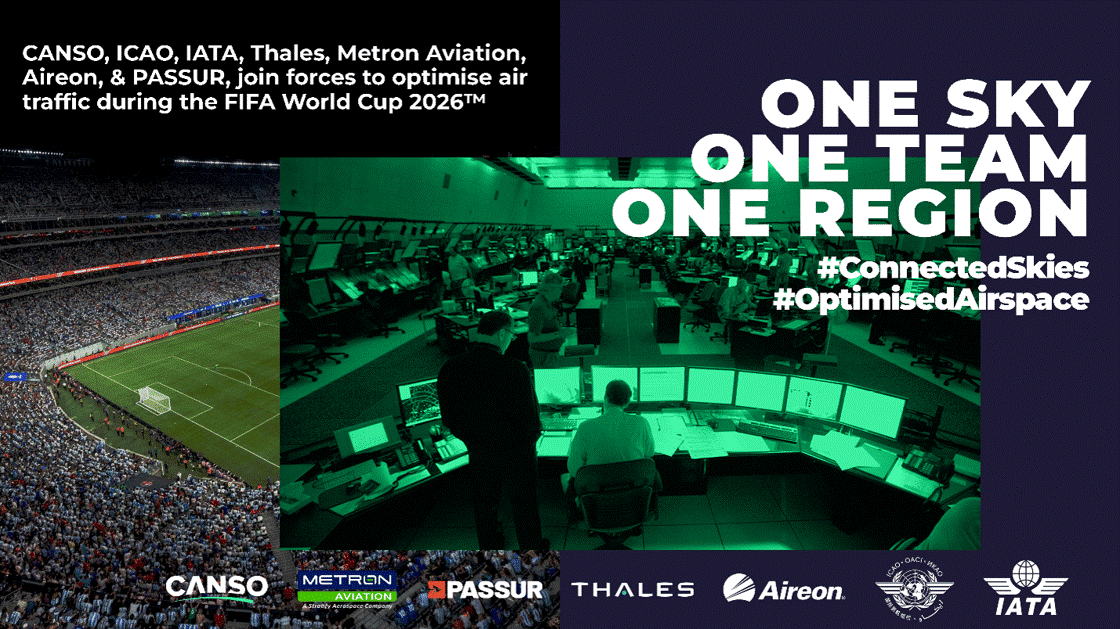
As the FIFA World Cup 2026™ heads toward its final at MetLife Stadium on Sunday 19 July, aviation organisations across Latin America and the Caribbean (LAC) are working together to keep flights safe and on time, even as passenger numbers reach record levels.
Under the banner One Sky, One Team, One Region, CANSO (Civil Air Navigation Services Organisation), the International Civil Aviation Organization (ICAO), the International Air Transport Association (IATA), Thales, Aireon, PASSUR Aerospace and Metron Aviation have joined forces to coordinate air traffic across the whole region – the first time this has been done for a global sporting event. Air navigation service providers (ANSPs), airlines and international organisations are now working as one network, while each country keeps control of its own airspace.
The initiative builds on an existing ICAO regional framework for cross-border cooperation, adding new technology from industry partners. Thales’ TopSky Flow Management system helps controllers plan and adjust air traffic across several countries in real time. Aireon tracks aircraft using a network of satellites, giving controllers visibility over ocean and remote areas where ground radar cannot reach. PASSUR Aerospace’s ARiVA platform gives teams in different countries a shared, real-time view of flights and airport activity, so they can respond together. Metron Aviation’s flow management tools help planners anticipate busy periods well in advance and spread demand more evenly across the network.
This year’s tournament is the biggest in the World Cup’s history, with 48 teams, 104 matches and 16 host cities across the United States, Canada and Mexico. Millions of fans have travelled through Latin America and the Caribbean – home to some of the busiest and most complex airspace in the world – pushing air traffic well beyond normal levels.
“This is about far more than managing one tournament,” said Javier Vanegas, Director, Latin America and Caribbean, CANSO. “By working as one region, we have shown that our members, airlines and partners can share information and make decisions together, in real time. That way of working will not stop when the final whistle blows – it is now part of how we plan for the future of our region.”
The One Sky, One Team, One Region initiative was never meant to be a one-off plan for the World Cup. As Vanegas adds: “It has set a new, lasting standard for cooperation in air traffic management across Latin America and the Caribbean. The tools, relationships and daily coordination built during the tournament will continue long after the trophy is lifted, giving the region a stronger foundation for managing air traffic together in the years ahead.”
Daily coordination calls, run through CADENA (the CANSO Air Traffic Flow Management (ATFM) Data Exchange Network for the Americas), have been central to this effort – bringing together air navigation service providers, airlines, ICAO, CANSO, IATA and other partners each morning to share information, agree priorities and prepare for surges in traffic. This helped prevent major delays at key points across the network throughout the tournament, as well as demonstrably improving situational awareness for air traffic controllers.
One of the tools supporting this work is COMPASS – CANSO Operational Messaging Platform for ATFM Sharing and Synchronisation, an information-sharing platform managed by Metron Aviation in partnership with CANSO. COMPASS gives air navigation service providers a shared, up-to-date picture of traffic across the region, helping them spot possible delays early and resolve them before they affect passengers.
Latin America and the Caribbean now moves into the post-tournament period with stronger data-sharing, tested cooperation between countries, and relationships that position the region as a global leader in collaborative air traffic management.







.jpg)

.png)


Comments
There are no comments yet for this item
Join the discussion