
Ways to make air transport more climate-friendly – the D-KULT project
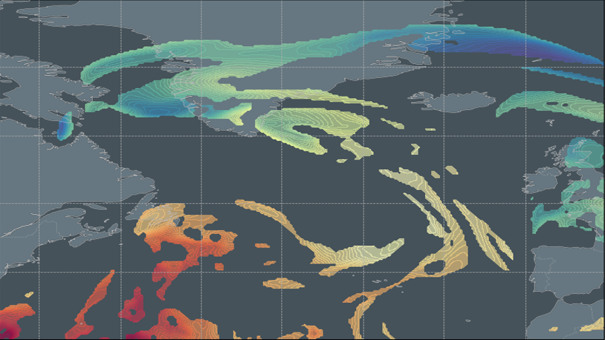
The completion of the German D-KULT research project at the end of 2025 marks the first time that practical results on how to avoid climate-impacting contrails in aviation are available. Research shows that strategically optimising flight planning to reduce climate impact offers opportunities, but that further research is needed.
Project launch in 2022
The D-KULT project was funded by the German Federal Ministry for Economic Affairs and Energy (BMWE) and ran from June 2022 to August 2025 as part of the LuFo VI-2 aviation research programme. Among the partners were the German Aerospace Centre (DLR), DFS, the German Meteorological Service (DWD) and German airlines. The D-KULT project name derives from the German for 'demonstrator for climate and environmentally friendly air transport'. The aim of the project was to develop procedures to reduce the climate impact of air traffic. The main way of doing this was for aircraft to avoid flying through areas where ice-saturated air layers cause long-lasting, or persistent, contrails to form. These so-called potential persistent contrails, or PPC, contribute significantly to global warming.
Two research approaches
In one approach, the researchers analysed tactical avoidance. Tactical avoidance involves air traffic control guiding aircraft around the relevant areas. Real-time simulations have shown that this approach was not practicable, however. Purely tactical re-routings lead to a 20 to 60 percent loss in airspace capacity and an increased workload for air traffic controllers.
Strategic avoidance is considered to be much more promising. Strategic avoidance would see airlines expanding their flight planning systems to include climate optimisation functions. Airlines would thus be able to select suitable routes before the flight took off. In one test with 100 flights, PPC areas were avoided in a targeted manner. However, this test was very time-consuming to plan and carry out manually, as it was based on individual flights. It is therefore not yet possible to transfer this approach into regular operations.
Intensive discussions – further research required
Further research has to be carried out before procedures can be used in regular operations. Researchers from the German Aerospace Centre (DLR) are currently investigating the effects on fuel consumption and the carbon footprint. One thing is clear: A positive climate impact will only occur if the benefits of flying around the areas exceed the additional CO₂ emissions required to do so. Initial calculations show potential but raise new questions. In addition, the underlying weather and climate data proved to be less robust than expected. DFS has intensified the scientific dialogue with the DLR and DWD to develop new approaches. The DLR is coordinating the D-KULT project and is itself involved with five institutes.
Commenting on the project, Arndt Schoenemann, CEO of DFS, said: "D-KULT has laid important foundations, but research must continue, both nationally and internationally." The goal remains a coordinated approach by airlines, air navigation service providers and the European air traffic control network management to effectively avoid climate-relevant contrails."
Image: ISSR North Atlantic
Climate-sensitive regions with the potential for the formation of persistent contrails.
Credit: DLR (CC BY-NC-ND 3.0)










.jpg)
.png)
Comments
There are no comments yet for this item
Join the discussion