
ENAIRE successfully completes three-year European SPATIO project and lays the foundations for the future U-space
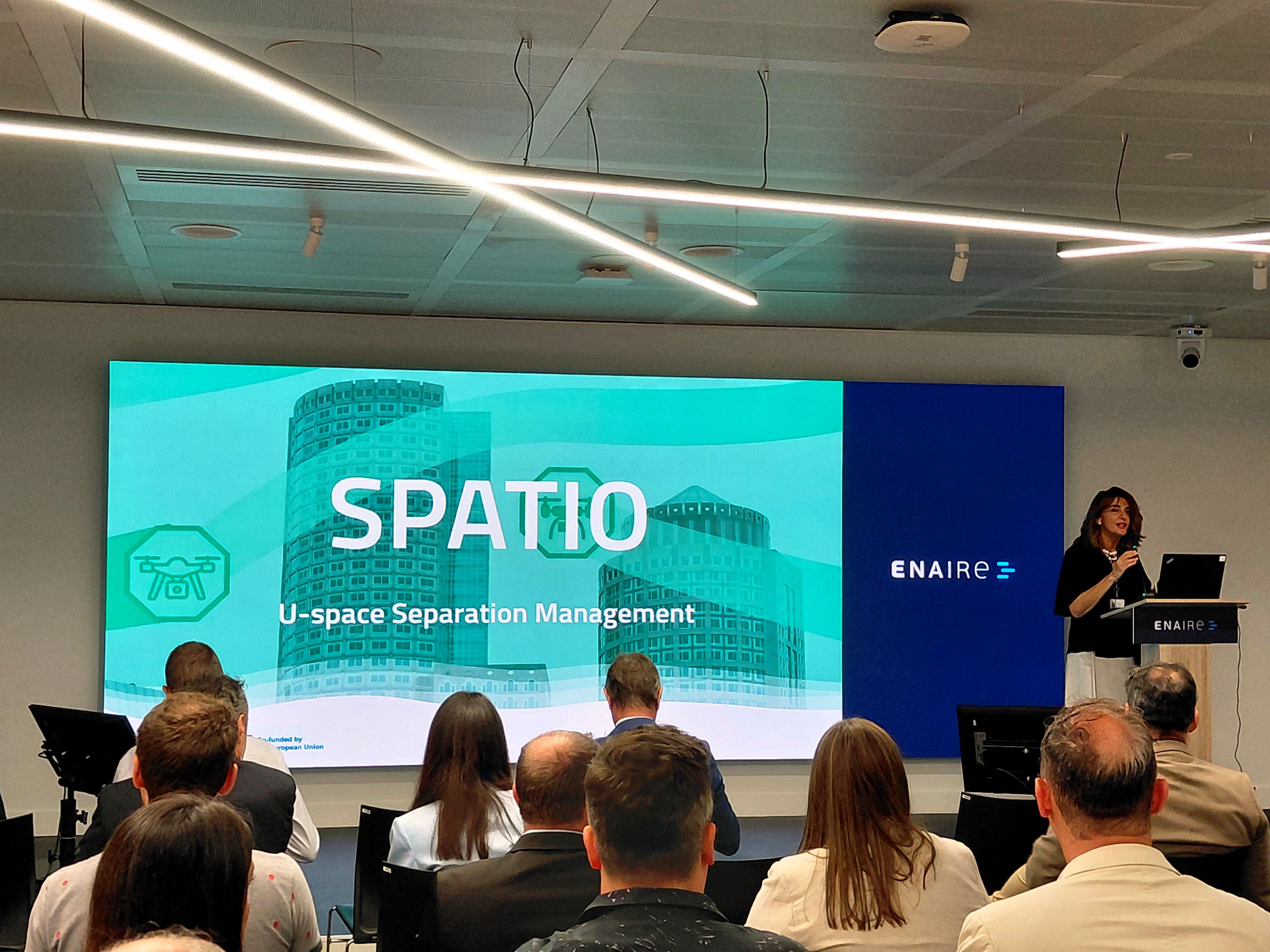
ENAIRE today hosted the final event to present the results of the European SPATIO project (u-Space sePAraTIOn management), bringing to a close three years of intensive research aimed at addressing one of the main challenges facing aviation today: safely integrating growing numbers of drones into increasingly complex and dynamic airspace.
The event brought together more than 60 attendees from 30 public- and private-sector companies and organisations in the aeronautical and technology sectors, including representatives from the Ministry of Science, Innovation and Universities, the Spanish Air Safety Agency (AESA) and the Directorate-General of Civil Aviation.
Led by ENAIRE through its R&D&I subsidiary CRIDA, and developed together with more than 20 European partners, the SPATIO project is a three-year strategic initiative of the SESAR 3 Joint Undertaking (2023–2026), aimed at developing advanced U-space services to support the safe integration of unmanned aircraft systems (UAS) into European airspace. The project receives €7 million in European funding under the SESAR programme through Grant Agreement No. 101114674. SPATIO has advanced the development of next-generation U-space services to support the safe and efficient management of large-scale drone operations. Partners based in Spain include CRIDA, Ineco, Indra, Boeing, ITG and Sopra Steria, as well as the Polytechnic University of Madrid and the Polytechnic University of València.
New services for drones
Over its three years, the project has developed and validated innovative solutions designed to improve separation management between unmanned aircraft. These capabilities combine advance planning of operations with real-time monitoring and control tools capable of anticipating and resolving potential in-flight conflicts.
SPATIO has also taken a significant step towards integrating drones in a socially acceptable way by developing dedicated services to identify, monitor and mitigate the noise impact of operations, keeping noise levels below thresholds that would cause disturbance to the public.
The project has also addressed ground safety through tools that can identify areas where operations over populated zones pose a higher risk of incidents and apply dynamic limits to unmanned aircraft traffic density, thereby strengthening protection for people on the ground.
Thanks to these advances, SPATIO has helped consolidate a model for U-space airspace capable of supporting high-density drone operations, an essential element in the deployment of the future Digital European Sky.
Demonstrations at four European sites
The solutions developed by SPATIO have been tested through multiple demonstration flights conducted in four different operational scenarios: Ireland, Romania and Spain, with tests in Spain conducted in Galicia and the Madrid Region.
These exercises have made it possible to validate the advanced services developed by the consortium in real-world conditions and demonstrate their potential to support increasingly safe, automated and scalable operations in the U-space environment.
From the laboratory to the real world
At the event held at ENAIRE headquarters, industry experts, regulators and representatives of public institutions examined the next steps needed to industrialise the solutions developed in SPATIO and bring them to market faster.
The results will support further progress towards deploying U-space services capable of meeting the expected growth in drone operations, helping strengthen Europe’s leadership in aeronautical innovation and advanced air mobility.



.png)







.jpg)
Comments
There are no comments yet for this item
Join the discussion