
EUROCONTROL Data Snapshot #59 on better "first wave" performance
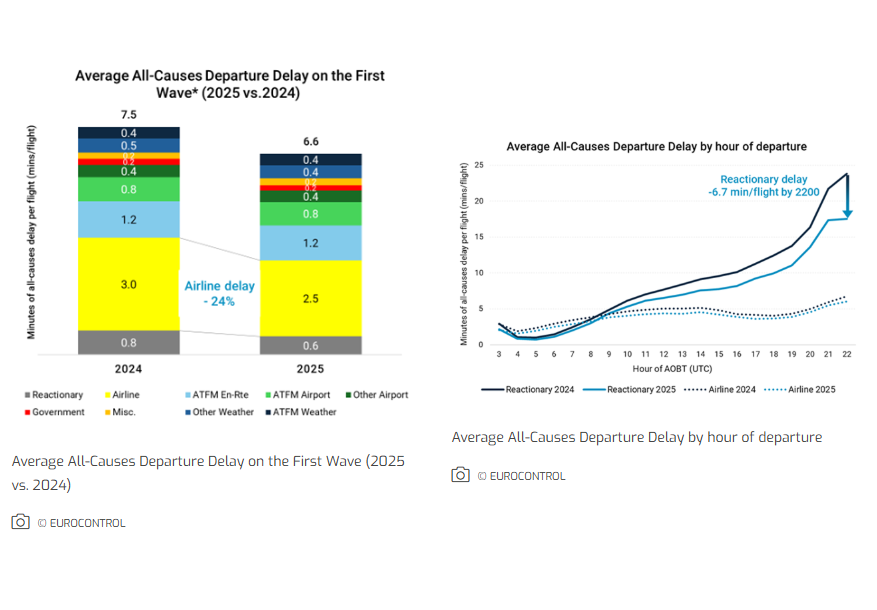
In 2025, the EUROCONTROL Network Manager identified five operational priorities to improve performance (#ThinkNetwork campaign), including prioritising the first rotations of flights (ones departing between 03:00–08:59 UTC). This reduces knock-on delays by ensuring a strong start to the day’s operations, and thereby improves the overall efficiency and resilience of the entire European air transport network. “First wave” flights – the first flights of aircraft during the first rotation period – are the most critical to safeguard good overall punctuality and avoid the build-up of knock-on delays throughout the day.
This Data Snapshot finds that all-causes departure delays in first wave flights decreased from 7.5 min in 2024 to 6.6 min in 2025, an improvement of 0.9 minutes per flight, and resulting in improved punctuality. Departures within 5 minutes of the schedule (OTP05) rose by 2.5% from 67.9% in 2024 to 70.4% in 2025. Similarly, departures within 15 minutes (OTP15) increased by 1.5%, from 88.0% to 89.5%.
A closer look at the drivers behind this first wave improvement shows that the largest contribution came from reduced airline delays. Although airline delays do remain the main delay driver, fewer ground handling, crew and technical issues saw such delays drop by 0.5 min/flight from 3.0 min in 2024, to 2.5 min in 2025. Key factors contributing to this were starting passenger boarding earlier on first wave flights compared to standard turnaround times, as well as earlier gate closures to safeguard on-time departures. Prioritising punctuality over passenger connections has reduced reactionary delays and contributed to improved departure performance. Smaller contributions to the overall improvement were also made by reductions in reactionary delays, en-route air traffic flow management (ATFM) delays, and other delay categories.
As well as having a better first wave, 2025 also saw additional initiatives and an increased focus by all stakeholders on improving operational performance, complemented by targeted airline schedule adjustments to maintain network integrity, all of which were reactions designed to tackle poor performance in 2024.
In 2025, all-cause departure delays for the full day, not just the first rotation, also fell, dropping by 2.8 minutes per flight from 17.5 min/flight to 14.7 min/flight, with reactionary delays decreasing by 1.5 minutes per flight year on year.
The analysis of delay evolution by hour (the right-hand graph) shows that airline-related delays were consistently lower across all hours in 2025. Benefiting from network effects, reactionary delays increased at a lower rate throughout the day, resulting in cumulative reductions of 6.3 min/flight by 22:00 UTC compared to 2024.
While only one part of the puzzle, the analysis shows that targeted reductions in first wave delays can improve overall network performance, limit the accumulation of delays throughout the day, and help ensure that evening and night flights are more likely to land at their planned destination and not fall foul of airport curfew restrictions.

.jpg)







.png)


Comments
There are no comments yet for this item
Join the discussion