
Finnish software-driven ATC training model targets global air traffic control training bottleneck
A new approach to air traffic control (ATC) training is emerging in Europe, as Finnish companies develop a software-driven training system designed to address one of the aviation industry’s most persistent structural challenges: limited training capacity.
Developed by air traffic control training organisation Lektor Aero in collaboration with software company Monad and simulation provider Adacel, the model shifts the focus of ATC training away from reliance on scarce, instructor-led simulator sessions towards continuous, data-driven learning supported by software and artificial intelligence.
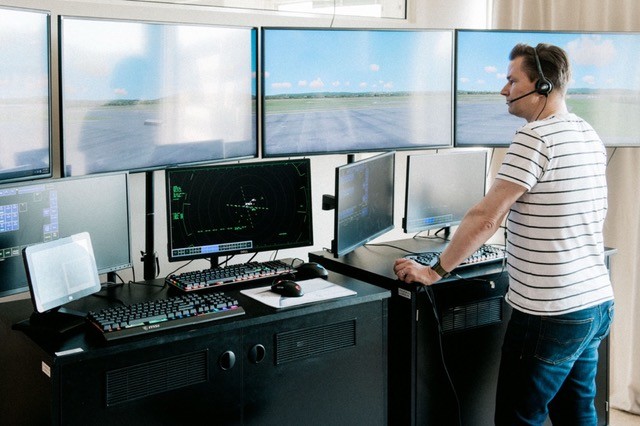
While a high-fidelity simulator has been installed as part of the development environment, the core innovation lies not in the hardware itself, but in the software layer integrating simulation, learning systems, data and AI into a unified training architecture.
“The industry has relied on the same training model for decades, centred around limited simulator access,” said Samuli Suokas, CEO of Lektor Aero. “The challenge is not only capacity, but the structure of training itself. We need models that scale without compromising quality.”
A structural constraint in a growing industry
Air traffic volumes have recovered and continue to grow, placing increasing pressure on the training pipeline for air traffic controllers. Across multiple regions, training throughput is constrained by the availability of simulators, instructors and support personnel.
Traditional training models require significant resources for each simulation session, creating a bottleneck that limits both the number of trainees and the pace of progression.
In addition, training outcomes remain inconsistent. A proportion of trainees fail to reach required performance levels within the system, highlighting challenges not only in capacity but in the effectiveness of existing training approaches.
From simulator sessions to continuous learning
The model under development introduces a shift from scheduled, instructor-dependent simulator sessions to continuous, software-supported training.
Trainees can engage in simulation-based exercises outside of traditional simulator environments, with performance data captured and analysed to support progression. Artificial intelligence is used to provide feedback and adapt training scenarios, enabling a more individualised learning path.
“Without software, a simulator is a standalone device,” said Tomi Äijö, Head of AI at Monad. “With the right software layer, it becomes part of a system where learning can be measured, analysed and continuously improved.”
This approach allows trainees to build foundational skills through repeated practice before entering high-fidelity simulation environments, potentially improving both training efficiency and outcomes.
Integration, not replacement
The system is not designed to replace traditional simulators, but to extend and integrate them into a broader training ecosystem.
By combining physical simulation with digital learning environments, the model aims to:
- improve learning outcomes and reduce training attrition
- increase training throughput
- improve readiness before simulator sessions
- reduce reliance on instructor-intensive training phases
- provide measurable insight into learning progression
The simulator itself functions as a development and validation platform within this broader system.
From training solution to exportable model
The initiative is positioned as a scalable training concept aimed at international markets where demand for air traffic controllers exceeds available training capacity.
Rather than exporting standalone technology, the approach combines:
- training methodology
- software systems
- simulation integration
into a unified model that can be adapted to different regulatory environments.
Lektor Aero operates as a certified air traffic controllers training organisation within Europe and focuses on international training markets.
Software at the core of transformation
For Monad, the project reflects a broader shift in how complex, safety-critical domains are being transformed through software.
“The key innovation is not in simulation hardware, but in how software connects simulation, learning and data into a single system,” Äijö said. “This is where meaningful change happens, especially in environments where decisions directly impact safety.”
.png)
.jpg)









Comments
There are no comments yet for this item
Join the discussion