
Frequently asked questions about Higher-Altitude Platform Systems (HAPS) answered by experts
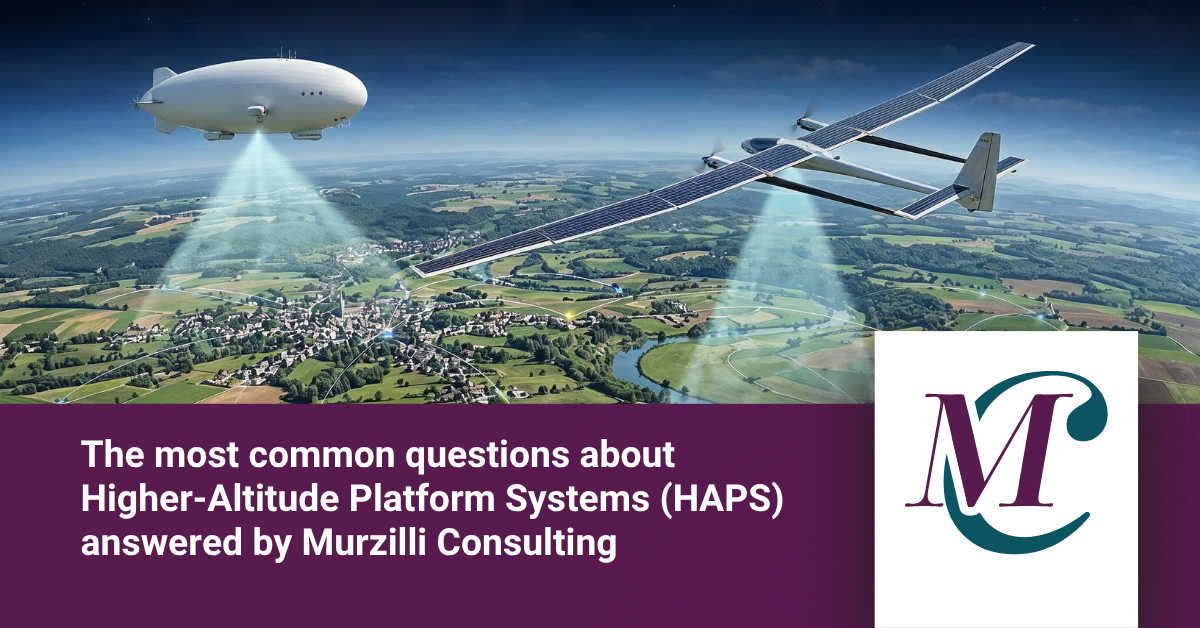
In the increasingly complex aviation ecosystem, Higher-Altitude Platform Systems (HAPS) are emerging as a new operational layer in the stratosphere, creating new possibilities for connectivity, surveillance, and environmental monitoring.
In this article, experts from Murzilli Consulting answer some of the most common questions about Higher-Altitude Platform Systems, including the advantages, societal benefits, challenges, and regulations applicable to higher-altitude operations.
What are Higher-Altitude Platform Systems (HAPS)?
Higher-Altitude Platform Systems are unmanned aircraft operating in the stratosphere, above the altitudes where most of the current air transport services take place, typically considered to begin above approximately FL550 (55,000 feet).
They provide persistent high-altitude services across multiple airspace layers, including communications, surveillance, and environmental monitoring. HAPS operations differ from conventional UAS operations, as they are characterised by relatively low mass, low wing loading, as well as limited manoeuvrability, and they take long-endurance missions over large airspace volumes.
What types of vehicles are used as HAPS?
Higher-Altitude Platform Systems generally fall into two main categories: Heavier-than-Air (HTA) and Lighter-than-Air (LTA) platforms.
Heavier-than-Air are fixed-wing aircraft that are sustained by aerodynamic lift. These aircraft are typically solar powered with a large wingspan and lightweight structures to enable long endurance operations lasting weeks or months. An example of this is solar-powered pseudo-satellites.
Lighter-than-Air aircraft are aerostatic platforms, including balloons and airships, which rely on buoyant gases such as helium or hydrogen to generate lift. They can maintain station through propulsion systems and by managing wind currents at different altitudes. As LTA platforms have lower mobility, they are more suitable for persistent coverage of a fixed area.
HTA and LTA aircraft are developed for different use cases, including telecommunications, environmental monitoring, disaster management, and military surveillance. The choice between HTA and LTA depends on mission requirements, including endurance, payload capacity, mobility, and operational cost.
Fixed-wing HAPS are generally closer to the pseudo-satellite concept, as they are Heavier-than-Air systems with active station-keeping capabilities. In contrast, Lighter-than-Air platforms such as balloons are typically more dependent on wind patterns and offer more limited positional control.
What are HAPS used for?
Primary use cases of HAPS include telecommunications and connectivity. HAPS can bring internet access to underserved regions where terrestrial infrastructure is limited and can quickly restore communication networks after outages. Compared to satellites, HAPS offer lower latency and stronger signals due to their closer proximity to Earth, making them capable of high-capacity coverage. HAPS can also be used to deliver broadcast services such as television, radio, or live event coverage over large areas.
HAPS are ideal for continuous, high-resolution monitoring of the Earth’s surface and atmosphere. Higher-Altitude Platform Systems can collect data on atmospheric conditions, greenhouse gases, and weather patterns.
HAPS can be used for environmental monitoring, including tracing wildlife movements, deforestation, and pollution. Agriculture can also benefit from these aircraft through crop monitoring, soil analysis, and irrigation planning.
Higher-Altitude Platform Systems can be deployed after disasters to support emergency operations. They can provide high-resolution imaging and video for assessing damage, support search and rescue operations, and establish temporary connectivity when ground infrastructure is destroyed.
An important use of HAPS is civil and military surveillance. Due to their long endurance and wide-area coverage, they are used for border monitoring, maritime surveillance, military intelligence, surveillance, and reconnaissance.
What are the main advantages and societal benefits of HAPS?
Higher-Altitude Platform Systems have several important advantages and use cases that bring benefits to society. HAPS can remain in the stratosphere for weeks or even months and maintain a fixed position (station-keeping), unlike satellites, which move in orbit. Furthermore, as they are much closer to the Earth than satellites, they can provide better imaging and stronger communication signals, while covering hundreds of kilometres in radius. HAPS can be stationed precisely over areas needing service and provide continuous, high-bandwidth service to a specific region.
As HAPS can be launched, repositioned, or recovered much faster than satellites, they can be deployed to disaster zones within hours or days. HAPS are also generally less expensive to develop, launch, and maintain. They are often designed for reuse, lowering the long-term operational costs. HAPS can operate in areas with no existing power grid or physical fibre-optic connectivity, making them able to bring infrastructure to remote areas.
From agriculture to connectivity and maritime safety, the benefits of HAPS operations can have a significant positive impact on society. They can play a key role in providing high-speed internet to rural or mountainous communities that are hard to reach with traditional infrastructure.
In cases of natural disasters, where ground infrastructure is destroyed, HAPS can immediately restore communication for first responders and provide emergency data services to affected populations.
As it is equipped with high-resolution sensors, HAPS can monitor deforestation, track climate change patterns, and assist in precision agriculture. By monitoring crops from the stratosphere, farmers can optimise water and fertiliser use, reduce environmental impact, and increase food security.
HAPS can also provide improved air traffic and maritime safety by providing persistent monitoring of remote airspace and shipping lanes, enhancing safety and traffic management in areas without strong radar coverage. HAPS can also be deployed for persistent, cost-effective surveillance of border regions and critical infrastructure, contributing to regional safety.
What are the main challenges of HAPS operations?
Despite their potential, HAPS operations present a range of complex technical, environmental, operational, and regulatory challenges. These issues reflect the demanding nature of long-endurance flight in the stratosphere.
One of the biggest challenges is maintaining a continuous energy supply. HAPS rely heavily on solar energy during the day and batteries at night. Long nights, especially at high latitudes or in certain seasons, can create an energy deficit problem. Batteries must be extremely lightweight but have a high capacity.
Although the stratosphere is more stable than lower altitudes, it can still present extreme atmospheric conditions. For example, strong winds can push platforms off systems, making precise positioning difficult. Extreme temperatures in the stratosphere can affect materials and battery performance.
HAPS platforms must be lightweight to stay aloft for long periods of time. The strict weight limitations restrict sensor, communication, and power equipment. Reliable connectivity between HAPS and ground systems is also challenging. This requires high-bandwidth, low-latency links over large distances, which must avoid interference with satellites, aviation systems, and terrestrial networks.
HAPS operate in a relatively new and evolving regulatory space. As there’s no fully harmonised global framework for Higher-Altitude operations, certification and operational authorisations processes for HAPS can be prolonged.
What regulations apply to HAPS?
As regulations for Higher-Altitude Platform Systems are still evolving, HAPS are governed by a combination of aviation rules and emerging international frameworks, rather than a single dedicated global regulatory framework.
The International Civil Aviation Organization (ICAO) provides general principles for airspace safety but does not have a dedicated HAPS certification standard. HAPS must comply with general aviation safety principles, especially regarding collision avoidance, airspace coordination, and risk to unmanned aircraft during ascent/descent.
The European Union Aviation Safety Agency (EASA) is assessing HAPS under the drone regulation (EU 2019/495 and 2019/497), because they are flying aircraft without a pilot on board, and considering a new specific regulatory framework for them, since no fully dedicated HAPS category exists yet. Integration into airspace must align with ATM/ANS rules for airspace integration and coordination, and a customised UTM framework for high altitudes is being considered. Safety risk assessments are based on adapted methodologies such as the Specific Operations Risk Assessment (SORA) for unmanned systems.
HAPS are classified as unmanned aircraft since they operate in continuous flight and rely on aerodynamic lift to remain airborne. As a result, their operations fall under the scope of Regulation (EU) 2019/947, which establishes the regulatory framework for unmanned aircraft systems (UAS) in Europe.
Many HAPS, especially Heavier-than-Air (HTA) platforms, are treated similarly to large unmanned aircraft. They must comply with UAS operational risk frameworks such as SORA in Europe. The operational approval depends on air risk and ground risk classification, Operational Safety Objectives (OSOs) and mitigation planning.
For HAPS operations, airspace design and characterisation play an important role in safety assessment and must be addressed within the operational approval process. This includes defining operational, contingency and emergency procedures, and adjacent airspace volumes, as well as assessing horizontal and vertical boundaries, climb and descent corridors, and interaction with surrounding IFR and controlled traffic.
Airspace analysis should also consider potential vertical containment scenarios, ensuring that risk is assessed not only at the intended operating altitude but also across lower airspace layers in the event the aircraft descends to lower altitudes. Appropriate mitigations may include airspace segregation, coordination with Air Navigation Service Providers (ANSPs), procedural coordination, monitoring and contingency and emergency handling.
For HAPS, the ground risk assessment should not be based solely on aircraft size but must also consider key characteristics such as low mass, low wing loading, reduced kinetic energy, and planned operations over remote or sparsely populated areas.
Based on the current regulatory framework, Murzillli Consulting supported Spain’s first authorised civilian Higher-altitude Platform System Flight, launched from the Canarias Stratoport for HAPS and UAS, located at the Parque Tecnológico de Fuerteventura in the Canary Islands. Murzilli Consulting enabled the operation through the development of a regulatory strategy, airspace design support, a safety framework, and coordination with the corresponding authorities.
What types of facilities or infrastructure are required for take-off and landing?
Higher-altitude operations require dedicated ground infrastructure for their unique operational needs, called stratoports. Unlike conventional aviation infrastructure, stratoports must accommodate large-sized, lightweight structures with sensitivity to environmental conditions that characterise many Higher-Altitude Platform Systems. Stratoports enable the launch and recovery of operations, aircraft preparation and maintenance, mission control and telemetry, and meteorological monitoring also for high altitudes.
Stratoports are usually located in remote or sparsely populated areas to reduce operational risk and simplify airspace integration. They also incorporate command and control centres, weather monitoring systems, maintenance and storage facilities, and communication links with air traffic management services.
The Canarias Stratoport in Fuerteventura is an example of this infrastructure. Its location near the Atlantic Ocean enables safe operational corridors, while also allowing integration with existing aviation infrastructure and testing facilities.
What international initiatives are currently in place?
Several international initiatives are currently underway to support the safe integration, standardisation, and large-scale deployment of Higher-Altitude Platform Systems.
The EASA is leading efforts to create a dedicated regulatory framework for higher airspace. The agency is developing a regulatory framework for Higher Airspace Operations (HAO). This initiative aims to address safety and security risks, environmental and cybersecurity considerations.
The HAPS Alliance is an international industry initiative that brings together stakeholders from the aviation, telecommunications, and technology sectors. It develops white papers and industry guidance addressing certification pathways, safety and risk metrics, fleet operations and traffic management.
A recent initiative proposes global “digital skies” for higher airspace, including cross-border traffic management concepts, globally harmonised cooperative zones, and federated digital infrastructure.
The Joint Authorities for Rulemaking on Unmanned Systems (JARUS) is actively working on HAPS-specific guidance. The Certification Specifications for HAPS (CS-HAPS) focuses on airworthiness recommendations, guiding the type certification process to ensure their safe, secure and sustainable integration into global airspace.
The International Civil Aviation Organization (ICAO) plays a central role in establishing a globally harmonised framework for Higher Airspace Operations (HAO). Through its Assembly and Air Navigation Commission, it is developing guidance and may update its Standards and Recommended Practices (SARPs) to include operations like HAPS. Its work focuses on global interoperability, safe integration into existing air traffic management systems, and new communication, navigation, and surveillance needs.
In Spain, a national HAO working group lead by the Spanish Aviation Safety and Security Agency (AESA), supports broader European coordination efforts. It brings together aviation authorities, ENAIRE, industry and research bodies to align with the regulatory framework of European Union Aviation Safety Agency (EASA) and European initiatives such as SESAR Joint Undertaking. The group focuses on use cases, regulatory gaps, airspace integration challenges, and contributions to concepts such as the European concept for higher airspace operation (ECHO).
In the United States, NASA is advancing higher airspace integration through the Upper Class E Traffic Management (ETM) project. Building on unmanned aircraft traffic management (UTM), it is developing scalable, automated systems with capabilities like shared situational awareness, conflict detection, and support for station-keeping operations. Research includes simulations and testing with industry partners, with results intended for transfer to the Federal Aviation Administration (FAA).
How HAPS differ from spaceflight?
Higher-Altitude Platform Systems differ from spaceflight in terms of operational environment, technical characteristics, and mission profile, even though both operate at very high altitudes and can provide similar services such as communications or Earth observation.
HAPS operate in the stratosphere, typically at altitudes of 18–25 km. They remain within the Earth’s atmosphere and are sustained by aerodynamic lift or lift generated by buoyant gas. Spaceflight systems (satellites) operate in outer space, generally above 100 km, and operate based on orbital mechanics without requiring lift after reaching orbit. Higher-altitude operations are complicated by atmospheric conditions such as wind and temperature, while spacecraft must withstand vacuum, radiation, and orbital mechanics.
Some HAPS can maintain a fixed position or operate within controlled margins in their operational environment (station-keeping) over a specific area, and can be repositioned or recovered, whereas others are more heavily dependent on wind conditions. Satellites typically orbit the Earth and have a limited ability to reposition and cannot be easily recovered.
HAPS are launched from the ground, and they are reusable, recoverable, and can be maintained and upgraded. Spacecrafts require rocket launches and are generally not recoverable or repairable. This makes HAPS more adaptable and cost-effective for certain operations.
HAPS have lower development and deployment costs, and they can be deployed in a shorter time compared to spaceflight. Spaceflights have high launch costs and long development timelines.
As HAPS are much closer to Earth, they are designed for regional or localised operations, including connectivity, surveillance, and environmental monitoring, while satellites are intended for global or large-scale missions such as navigation systems and global communications.
About Murzilli Consulting
Murzilli Consulting is a digital aviation consultancy business unit operating within the M&K Global AG group. It was founded in 2020 by Lorenzo Murzilli and is based in Bern, Switzerland, with further branches in Germany, the United Kingdom, Hungary and Spain. The organisation is committed to helping clients succeed with their technology, regulation, and compliance strategies. We do this by acting as a digital outsourced regulatory department and working with clients to support them in establishing a high-performing internal regulatory function. Our primary focus is on emerging technologies in the sectors of crewed and unmanned aviation, advanced air mobility, and U-space (including all derivative focuses).
The Murzilli Consulting team offers governments and private enterprises alike the opportunity to establish a high-performing internal regulatory function capable of tackling emerging technologies. We can also develop and implement regulatory strategies and roadmaps as well as execute specific projects such as UAS and USSP certification, type certification, design verification, SORA approvals and CE marking, among other services. Our customer base is unrivalled in the consulting and services industry and reflects the trust that leading organisations have in our services.

.jpg)

.png)








Comments
There are no comments yet for this item
Join the discussion