
Guide to finding the right UAS test centre for drone testing, validation, and deployment
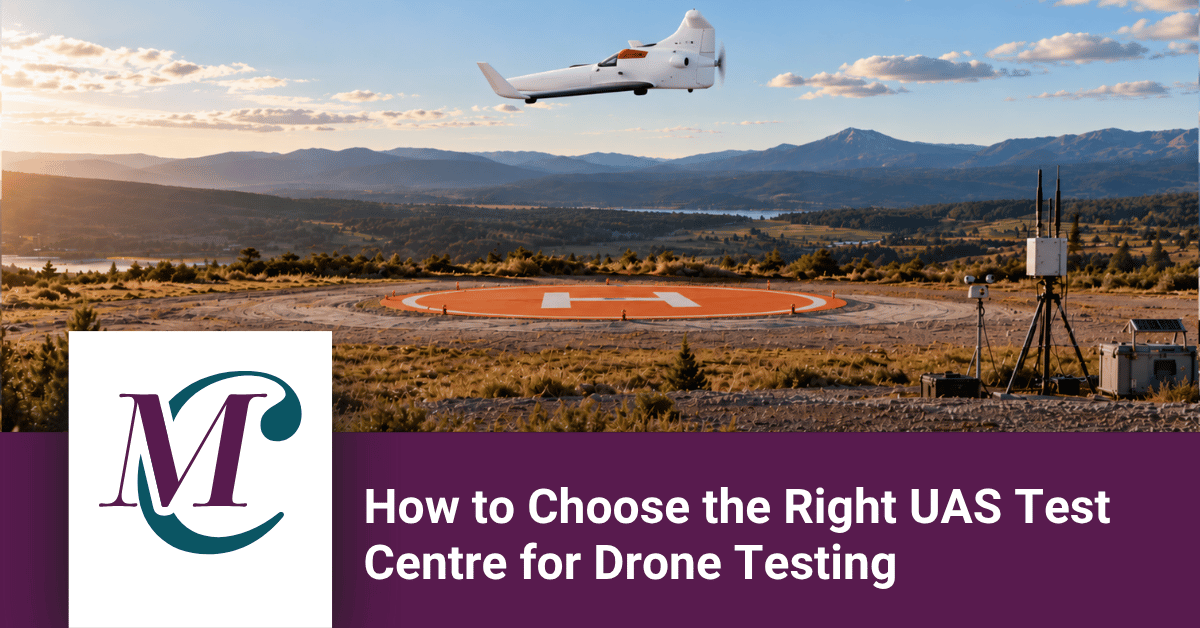
What UAS developers, operators, authorities, and end users should assess before moving from testing towards approval and deployment.
This guide is for organisations across the uncrewed aircraft systems (UAS) ecosystem seeking to select or compare test environments, including aircraft manufacturers, UAS operators, technology providers, research organisations, public authorities, emergency services, and end users. It explains what each type of organisation should consider when assessing a test centre, such as airspace and operating environment, infrastructure, testing capabilities, evidence generation, regulatory support, and access to the wider drone ecosystem. It also examines seven European UAS test centres with different capabilities. The guide concludes with a practical procurement checklist to help organisations identify the test environment best aligned with their technical, operational, and regulatory objectives.
Choosing a UAS test centre starts with what you need to prove
A UAS test centre is far more than a place to fly. Its value lies in what the test campaign can prove.
For aircraft manufacturers, UAS operators, technology providers, public authorities and end users, the objective is to generate credible evidence on aircraft performance, system limitations and operational suitability to support the next stage of development, regulatory approval or deployment.
What needs to be proved differs across the drone ecosystem. An aircraft manufacturer may need to validate performance, reliability, or the flight envelope. A UAS operator may be preparing for beyond visual line of sight (BVLOS) drone operations or an application in the Specific Category. A technology provider may need to assess command and control (C2), detect and avoid (DAA), navigation, or payload performance. Public authorities, emergency services, and end users may seek to demonstrate operational suitability, safety, or the viability of a specific use case. Research organisations, air navigation service providers (ANSPs), and U-space stakeholders may have different requirements, especially when testing involves airspace integration or new operational concepts.
There is no single test centre suitable for every programme. The right choice depends less on finding the largest range, longest runway, or most extensive facilities, and more on matching the test environment to what the organisation needs to prove. A campaign may need to expand the flight envelope, validate BVLOS drone operations, assess DAA or C2 performance, generate regulatory evidence, or demonstrate that a proposed operation can perform safely and reliably under representative conditions.
Together, these five factors provide a practical way to compare test centres beyond headline specifications. A facility may offer extensive airspace but still be unsuitable if it cannot reproduce the intended operating environment, provide the equipment needed to measure and record test results, or generate evidence supporting the programme’s regulatory pathway.
From UAS flight testing to SORA 2.5 and regulatory evidence
At a minimum, a professional test environment should provide lawful access to suitable airspace, a managed ground environment, safety and emergency procedures, competent personnel, reliable meteorological information, basic communications, and dependable data capture. For advanced BVLOS drone operations, requirements expand to surveillance, C2 performance, remote identification (Remote ID), U-space or Unmanned Aircraft System Traffic Management (UTM) interfaces, DAA, cybersecurity, navigation resilience, and standards-based test methods.
The decisive question is not just whether a centre can host the flight but what usable evidence the programme will have when testing is complete. Flying is not necessarily testing. Repeatable scenarios, defined success criteria, independent measurements, and traceable records turn a series of flights into a structured test campaign.
Depending on the programme and regulatory pathway, this evidence may support operational authorisation, a Specific Operations Risk Assessment (SORA), Conformité Européenne (CE) marking, design verification, or certification activities. The test plan should be developed with the intended regulatory outcome in mind rather than treating regulatory compliance as a separate activity after flight testing.
Why the drone ecosystem matters when selecting a UAS test centre
Modern UAS development rarely sits within one discipline. Advanced aviation programmes increasingly depend on airspace management, communications, navigation, software assurance, cybersecurity, regulatory strategy, public acceptance and integration with the conventional aviation system.
The relevant ecosystem may also extend beyond the test centre itself. Industry clusters, research networks and specialist suppliers can provide access to capabilities that are not permanently located at the range. For developers, this can mean access to specialist engineering expertise, ANSPs, telecom providers, regulators, research institutions and potential deployment partners.
The Swiss Aerospace Cluster provides one example of this wider ecosystem model. Its network brings together aerospace suppliers, research institutions, service providers and downstream organisations, including a dedicated Drones & UAS working group. For Swiss aviation companies and international developers entering the market, this type of network can help connect technology testing with knowledge transfer, specialist expertise and potential industry partners.
European UAS test centres for BVLOS drone operations and advanced aviation
The following seven European facilities illustrate how different combinations of airspace, infrastructure, regulatory support, technical capabilities and operating environments can influence test-centre selection.
The centres are not presented as a ranking. Each represents a different testing proposition, from rapid product development and regulatory progression to BVLOS drone operations, DAA, U-space integration, advanced air mobility (AAM), high-altitude platform station (HAPS), and testing in representative operating environments.
BCN Drone Center: BVLOS drone flight testing and regulatory progression in Spain
BCN Drone Center, located in Moià, accessible from Barcelona, provides 50 km² of segregated airspace extending up to 4,500 ft above mean sea level (AMSL), along with a dedicated UAS airfield, runway, vertical take-off and landing (VTOL) area, hangar, workshop, and engineering facilities. Its segregated airspace and on-site infrastructure support UAS manufacturers and operators throughout aircraft development and BVLOS drone flight testing. This enables programmes to progress towards operational validation and commercial deployment.
A key differentiator is its end-to-end testing and regulatory proposition. BCN Drone Center operates a Light UAS Operator Certificate (LUC)-based sandbox supporting BVLOS drone flights, UAS over 25 kg, operations 120 m above ground level (AGL), and day/night testing. SORA and predefined risk assessment (PDRA) support, engineering support, and certification services can be integrated into the programme, while testing can extend beyond the centre to customer-site proofs of concept. For programmes where regulatory progression is as important as aircraft development, BCN Drone Center shows the value of selecting a centre that links flight testing to the next stage of operational deployment.
DTDC: UAS development and connected aircraft technology in the United Kingdom
Located at the former Royal Air Force (RAF) Westcott airfield in Buckinghamshire, the Drone Test and Development Centre (DTDC) combines controlled flight areas with four technical workshops, a 270 m runway, VTOL pads, a drone cage, and sensor-testing facilities. This makes it particularly well suited to drone technology developers and early- to mid-stage UAS programmes that need to build, modify, and repeatedly test aircraft, sensors, and supporting technologies within a controlled development environment.
DTDC’s principal strength is its develop-build-test-modify-retest environment. It is also listed by the UK Civil Aviation Authority (CAA) as a Pre-assessed Test Site for visual line of sight (VLOS) operations, allowing eligible operators to use pre-agreed site risk information when developing qualifying UK SORA Operational Authorisation applications. The CAA framework is limited to specific assurance and integrity level (SAIL) II operations involving aircraft with a maximum characteristic dimension of 20 m and a maximum speed of 125 m/s. For eligible programmes, this supports rapid technical iteration while simplifying regulatory preparation.
DLR Cochstedt: Advanced aviation testing and U-space integration in Germany
The German Aerospace Center’s (DLR) National Experimental Test Center at Magdeburg-Cochstedt supports advanced UAS, VTOL, and AAM programmes that require rigorous measurement, complex validation, and integration with conventional aviation. Operating within a commercial airport environment, the centre combines an approximately 220 km² Aerodrome Traffic Zone (ATZ) with a 2.5 km paved runway, hangars, laboratories, workshops, and stationary and mobile mission-control facilities. Its research infrastructure supports independent tracking, communications and navigation testing, DAA, U-space integration, safety, and certification activities.
A key differentiator is its permanent UAS GeoZone, established in November 2025 to facilitate more complex flight testing. Under defined operating and safety requirements, the GeoZone supports test activities including BVLOS drone operations, flights with UAS above 25 kg, and operations above 120 m AGL. Combined with DLR’s scientific infrastructure and real-world airport environment, this makes Cochstedt valuable for programmes that need to evaluate not only aircraft performance but also how a UAS interacts with the wider airspace and aviation system.
Swiss Drone Competence Center (SDCC): BVLOS drone testing in Alpine environments
Located at the former military airfield in Lodrino, Ticino, the Swiss Drone Competence Center combines visual line of sight (VLOS) and BVLOS drone testing and engineering support with a distinctive Alpine operating environment. Access to mountainous terrain, changing weather, and the wider Swiss aviation ecosystem make SDCC relevant for UAS developers and operators whose intended operations depend on terrain, altitude, infrastructure corridors, or representative Alpine conditions.
SDCC combines this operating environment with on-site prototyping, aviation expertise, regulatory and SORA support, and stakeholder coordination. For programmes intended to operate in mountainous or infrastructure-constrained environments, it demonstrates an important selection principle: the relevance of the test environment may be more valuable than the physical size of the range.
ATLAS Flight Centers: UAS, eVTOL and U-space integration in Spain
Operated by Centro Avanzado de Tecnologías Aeroespaciales (CATEC) in Jaén, the ATLAS Flight Centers combine two complementary facilities for experimental UAS and advanced aviation testing.
ATLAS ALPHA at Villacarrillo provides more than 1,000 km² of segregated airspace, extending up to 5,000 ft, with more than 300 operational days per year. ATLAS BRAVO, approximately 25 km away at Beas de Segura, adds a 1,500 m runway and the ability to operate both crewed and uncrewed aircraft.
A segregated corridor can connect BRAVO with ALPHA’s airspace, supporting transit testing, coordinated missions, and operations involving aircraft with different levels of autonomy.
Its distinguishing strength is the combination of large-scale flight-test infrastructure and CATEC’s engineering and operational expertise. ATLAS services include operations design, flight permit management, UAS pilots, onboard system and payload testing, flight coordination, and engineering support. Together, these complementary test facilities make ATLAS particularly relevant for larger UAS, electric vertical take-off and landing (eVTOL), and Advanced Air Mobility programmes that need to combine experimental flight testing with crewed-uncrewed integration and future U-space and air traffic management (ATM) concepts.
Canarias Stratoport: HAPS, UAS testing and U-space integration in Spain
Located in Fuerteventura, Canary Islands, Canarias Stratoport for HAPS & UAS is a public testing facility operated by Fuerteventura Technology Park (Parque Tecnológico de Fuerteventura, PTFSA). Designed for the research, development, testing and operation of uncrewed aerial platforms, the facility supports both UAS and HAPS programmes. Its infrastructure includes a 900 m paved runway, hangars, meteorological facilities and dedicated areas for flight operations. The Canarias Stratoport provides a shared testing environment for advanced aerial technologies, including HAPS, communications systems, and Earth observation applications.
A key differentiator is its infrastructure for both UAS and HAPS operations, along with capabilities that support advanced aviation testing and airspace integration. The facility provides an environment for evaluating uncrewed aircraft technologies, communications systems, and operational concepts, including applications requiring coordination with existing airspace users. For developers and operators, Canarias Stratoport offers opportunities to validate emerging aerial technologies and assess their potential for operational deployment, particularly in high-altitude operations and advanced air mobility.
Snowdonia Aerospace Centre: BVLOS drone operations, DAA and advanced airspace integration in the United Kingdom
Located at Llanbedr Airfield in Gwynedd, Wales, Snowdonia Aerospace Centre combines segregated airspace with the infrastructure of an operational airfield. Its facilities include three runways, with the longest measuring approximately 7,500 ft (2.3 km), UAS hangars, flight information and meteorological services, ground-based DAA radar, redundant automatic dependent surveillance–broadcast (ADS-B) receivers, 5G networks and broadband connectivity. The site manages Danger Areas EG D217A and D217B around Llanbedr, creating a particularly relevant environment for BVLOS drone operations, larger UAS and AAM programmes where surveillance and airspace integration are central to the test objective.
Snowdonia’s distinctive proposition is the combination of airspace that supports BVLOS drone operations, ground-based DAA, and conventional airport infrastructure. It is also listed by the UK CAA as a Pre-assessed Test Site for BVLOS operations, allowing eligible operators to use pre-agreed ground and air risk assessments when preparing UK SORA Operational Authorisation applications. The CAA framework supports operations up to SAIL II, subject to defined site conditions and aircraft limitations. For developers working on advanced BVLOS drone operations, Snowdonia demonstrates why the surrounding surveillance and airspace architecture can be just as important as the aircraft-testing facilities themselves.
Different test centres answer different programme needs
The seven examples demonstrate why test-centre selection should not be reduced to a comparison of runway length, airspace area or equipment.
- BCN Drone Center supports drone testing, regulatory validation and commercial deployment.
- DTDC enables rapid prototyping, testing and product development.
- DLR Cochstedt specialises in scientific validation and aviation system integration.
- Swiss Drone Competence Center (SDCC) provides UAS testing in representative Alpine conditions.
- ATLAS supports large-scale UAS, eVTOL and U-space/ATM integration testing.
- Canarias Stratoport supports HAPS and UAS development, flight testing and U-space integration.
- Snowdonia Aerospace Centre focuses on BVLOS, DAA and larger-aircraft testing.
For some programmes, more than one environment may ultimately be required. Early aircraft development, failure testing, regulatory evidence generation and representative operational validation do not necessarily need to take place at the same facility. The procurement question is not simply “Which test centre has the most capabilities?” but “Which environment provides the capabilities and evidence required for the next programme milestone?”
Questions to ask before starting a BVLOS drone flight test campaign
Selecting a UAS test centre should be a strategic procurement decision rather than just a question of airspace availability or facility cost. The centre should support required test scenarios, generate usable evidence, and contribute to the programme’s intended regulatory and deployment pathway. The following seven questions provide a practical checklist for comparing potential test environments, starting with the programme objectives and progressing towards evidence generation, regulatory approval and deployment.
- 1. What exactly must the programme prove?
Is the objective to validate technical performance, operational safety, regulatory compliance or commercial viability?
- 2. Does the environment represent the intended operation?
Can the airspace, terrain, weather and operating conditions support the required test scenarios?
3. Can the centre support the aircraft and relevant failure scenarios?
Does it accommodate the aircraft's characteristics, operating limitations and required safety procedures?
4. Does it provide the required technical infrastructure?
Are the necessary facilities, communications, surveillance, instrumentation and data-capture systems available?
5. What evidence will we have when testing is complete?
What measurements, test records and supporting documentation will be collected, and how will their quality and traceability be assured?
6. Can the evidence support the intended regulatory pathway?
Will the test results provide suitable evidence for the relevant safety assessment, operational authorisation or certification process?
7. What happens after testing?
Can the centre and its ecosystem support further validation, customer demonstrations or progression towards deployment?
From UAS testing to SORA 2.5, regulatory approval, and deployment
Selecting the test centre is not an isolated procurement decision. The test environment, campaign objectives, evidence requirements and regulatory pathway should be defined together so that each flight contributes to the next programme milestone.
For organisations planning BVLOS drone operations, AAM, HAPS or other advanced UAS programmes, this becomes increasingly important as the aircraft moves from technical development into a regulated aviation environment. A technically successful test campaign may still require additional work if the evidence produced does not align with the safety objectives, regulatory methodology, or operational conditions applicable to the intended deployment.
Murzilli Consulting supports UAS developers and operators in defining these requirements, from SORA 2.5 and BVLOS drone regulatory strategy to airspace integration, U-space and operational authorisation. Aligning the test campaign with the intended approval pathway from the outset can reduce duplicated testing and help ensure that the evidence generated is relevant to deployment.
Planning a UAS or BVLOS drone test campaign? Murzilli Consulting can help define the technical, operational, and regulatory requirements, assess suitable European test environments, and develop a clear route from testing to authorisation and deployment.


.png)






.jpg)


Comments
There are no comments yet for this item
Join the discussion