
Leading from the Front Line - How NAV CANADA Is Modernizing One of the World’s Largest Airspaces
From joining Europe’s iTEC Alliance to championing workforce diversity on the global stage, Canada’s air navigation service provider is charting an ambitious course forward.

Canada manages nearly 18 million square kilometres of airspace — the second-largest volume overseen by a single provider anywhere in the world. From complex southern corridors handling thousands of daily flights to Northern and Arctic routes where air transport is an essential link for remote communities, the diversity of operations in Canada is truly unique. So too is the challenge of keeping it all moving safely, efficiently and sustainably.
NAV CANADA, the country’s not-for-profit air navigation service provider, is meeting that challenge with a modernization agenda that is reshaping how services are delivered — and positioning Canada as a leading voice in the global evolution of air traffic management.
Joining forces with iTEC

Mark Cooper, NAV CANADA’s President and CEO
A centrepiece of that strategy is NAV CANADA’s entry into the iTEC Alliance, the influential coalition of European air navigation service providers developing next-generation ATM platforms. As iTEC’s first non-European member, NAV CANADA is extending the alliance’s footprint across the Atlantic — a move that signals both the maturity of Canada’s modernization ambitions and the value of deep international collaboration.
Through iTEC SkyNex, NAV CANADA is advancing trajectory-based operations – designed to deliver more predictable, fuel-efficient and flexible air traffic management. The platform supports a shift toward a gate-to-gate view on flow management, integrating airspace, weather data, airport capacity and demand in real time. Combined with the development of a national Canadian Network Management Unit, the result is a system built for the scale and complexity of Canadian operations — while maintaining full interoperability with international partners.
“Air navigation is more than an enabler of commercial aviation,” says Mark Cooper, NAV CANADA’s President and CEO. “It is dual-use national infrastructure that serves economic, security and sovereign purposes simultaneously. Modernizing it is not optional — it is how we keep pace with a world that is demanding more from our skies.”
The benefits are tangible: reduced delays, lower emissions from optimized routing, and smoother international traffic flows. For an industry navigating rising demand and increasing pressure to decarbonize, these are operational gains with strategic significance.
An operational leader at the helm
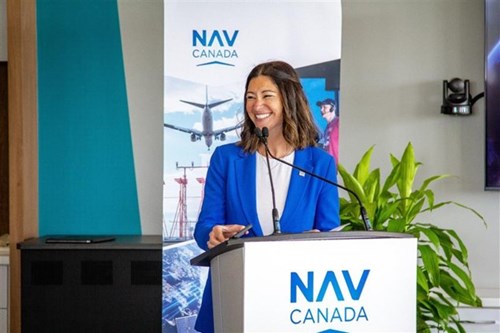
Marie-Pier Berman, NAV CANADA’s Vice-President and Chief of Operations
Overseeing the delivery of air traffic services across this vast network is Marie-Pier Berman, NAV CANADA’s Vice-President and Chief of Operations. Her path to the role reflects a career built on front-line experience: a commercial pilot by 19, an IFR air traffic controller by 21, and a progression through operational and leadership positions spanning more than two decades.
“No two days are the same,” Berman says. “The operational environment is dynamic — from dense traffic in the south to very remote northern operations — and that requires constant collaboration, adaptability and a strong safety culture.”
That culture of safety and collaboration is central to NAV CANADA’s approach. Canada’s airspace borders the United States, the busiest airspace in the world, and close coordination with the FAA and other international partners is a daily reality. But technology and systems only deliver results when they are backed by skilled, experienced people, and investing in that workforce is as much a part of NAV CANADA's modernization strategy as any platform upgrade.
“Aviation works best when it’s collaborative,” Berman says. “That strong coordination across countries, with operators, with regulators, is what keeps the system safe and helps us grow.”
Digital capabilities, from coast to coast to coast

Groundbreaking of Canada’s first digital air traffic facility in Kingston, Ontario (September 2025)
Groundbreaking of Canada’s first digital air traffic facility in Kingston, Ontario (September 2025)
Beyond iTEC, NAV CANADA’s modernization agenda spans a broad portfolio. Digital and remote tower technologies are soon to enable the management of multiple airports from a single location — increasing flexibility, resilience and sustainability while maintaining the safety standards that operators and communities expect. Modernized surveillance and communications systems, strengthened cyber-resilience, and enhanced Arctic weather observation capacity are all active priorities.
For Canada, where aviation connects communities that have no year-round surface transportation, these investments carry particular weight. A more capable system means faster emergency response, more reliable service to remote and northern communities, and infrastructure that can support both civil and defence operations.
A Canadian voice on the global stage
Berman’s influence now extends well beyond Canadian airspace. In February, she was named to the International Civil Aviation Organization’s inaugural cohort of Global Ambassadors — a select group of aviation leaders from around the world tasked with promoting the sector and inspiring the next generation of talent.
The appointment is a recognition of both Canadian expertise and Berman’s distinctive vantage point. Few aviation leaders bring the breadth of operational experience she does — from cockpit to control room to executive leadership — and she sees the ambassador role as an opportunity to bring that practical perspective to global conversations about the future of the industry.
“Canada brings a great deal of credibility to global aviation discussions,” Berman says. “We operate one of the largest and most diverse airspaces in the world, and that has required us to develop strong operational expertise, a deep safety culture and practical ways of managing complexity.”
The role also aligns with one of her core priorities: increasing the visibility of women in aviation. Women remain significantly underrepresented across the sector, accounting for just 5–7 per cent of pilot licence holders and less than 20 per cent of air traffic services personnel globally.
“Representation matters because it shapes what people believe is possible,” Berman says. “When women are visible in operational and leadership roles, it strengthens the industry and helps the next generation see that they belong in aviation — and can lead it.”
Building what comes next
Since assuming responsibility for Canada’s civil air navigation system in 1996, NAV CANADA has invested more than $3.5 billion in modernization under its not-for-profit, user-pay model. That foundation of sustained investment and operational independence has enabled the organization to move with purpose — adopting international best practices, forging strategic partnerships and continuously advancing the systems that underpin Canadian aviation.
The work ahead is significant. Rising traffic volumes, the integration of remotely piloted aircraft systems, and the need for ever-greater interoperability across borders will demand continued innovation and collaboration. NAV CANADA is building for that future — with the technology, the partnerships and the people to deliver it.
This article originally appeared in the ATC Network Special Bulletin on Training, Simulation and Recruitment. You can read the full publication here:
.jpg)




.png)






Comments
There are no comments yet for this item
Join the discussion