
Digital European Sky gets regional boost with SESAR - Campania agreement
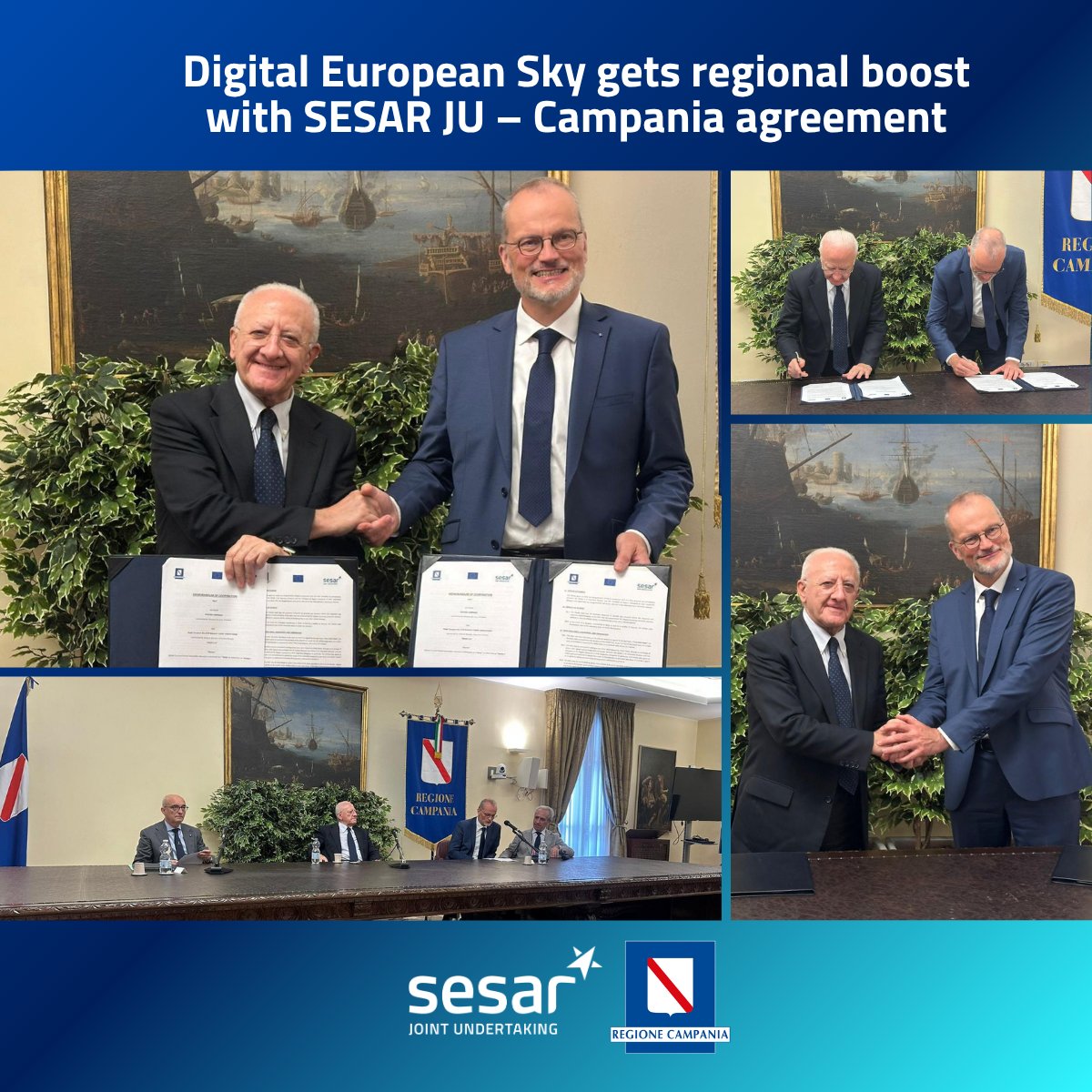
The Italian Region of Campania and the SESAR Joint Undertaking (SESAR JU) have signed a Memorandum of Cooperation (MoC) to align research and innovation (R&I) efforts and to maximise the impact of regional and European investments in air traffic management modernisation.
This is the first cooperation agreement of its kind between SESAR and a European region, highlighting the role regional actors can play in advancing the Digital European Sky and delivering Europe’s environmental and connectivity goals.
The MoC establishes a strategic framework to identify and activate synergies between SESAR JU’s work programme and Campania’s innovation strategies. Cooperation will focus on three main areas: developing a joint technical roadmap to align research and innovation priorities; identifying additional funding sources at European, national, and regional levels; and engaging local stakeholders — including SMEs and academia — to boost participation in SESAR activities.
The agreement supports Campania’s strategic priorities in advanced air mobility, with a particular focus on on-board and ground-based technologies, human-machine interfaces, autonomous systems, cyber security, and electric aviation. The Region’s Smart Specialisation Strategy (RIS3) and national collaborations, such as with the Italian Civil Aviation Authority (ENAC), provide a solid basis for coordinated innovation.
“This is the first time SESAR has signed a formal agreement with a European region,” said Andreas Boschen, Executive Director of SESAR JU. “By joining forces with the Campania Region, we can create the synergies needed to turn the vision of a Digital European Sky into a reality. This cooperation will help accelerate innovation, support skills development, and bring SESAR solutions closer to deployment.”
“This agreement recognises Campania’s longstanding commitment to innovation and its industrial strengths in aerospace,” said Vincenzo De Luca, President of the Region of Campania. “It will allow us to work more closely with Europe’s flagship air traffic management programme, attract investment to the region, support our SMEs and research centres, and ensure our workforce is equipped with the skills needed for the future of aviation.”



.jpg)



.png)




Comments
There are no comments yet for this item
Join the discussion