The pre-COVID baseline: A strong system with structural limitations
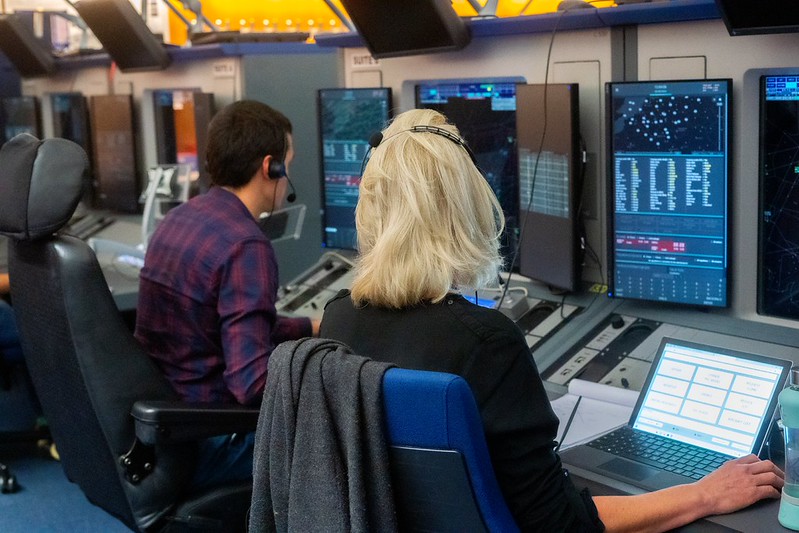
Before the pandemic, the training system of the EUROCONTROL Maastricht Upper Area Control Centre's (MUAC) was effective but firmly rooted in conventional methods. Training depended on classroom‑based theoretical instruction, on‑site simulator sessions supported by pseudo pilots, and instructor‑led feedback that was captured through largely manual report writing. Automation was limited, and although data existed, it was not systematically collected or analysed. The system performed well under stable conditions, yet it carried structural constraints: throughput was tied to physical presence, assessment quality relied heavily on individual instructor judgement, and modernisation efforts were progressing only gradually.
At the onset of the COVID-19 pandemic, MUAC recognised the situation as a short-term disruption, but one that could have severe long-term consequences if not handled decisively. While the pandemic itself was temporary in nature, halting or significantly reducing training would have created a structural gap with far greater and lasting impact; as subsequent industry trends have demonstrated MUAC was determined to prevent such an intake dip. Every possible method, including unconventional and out-of-the-box measures, were deployed to ensure continuity. Rather than treating the pandemic as a pause, MUAC used it as a catalyst for transformation.
Short-term measures - such as remote learning tools, reorganised simulator schedules, and hybrid teaching - were implemented to keep the pipeline moving. At the same time, these adaptations revealed deeper structural limitations within the training system.
To address this, MUAC initiated a strategic shift: the development of the Maastricht Upgraded Simulator Environment (MUSE), which later evolved into the Total Training Environment (TOTE). This initiative represents a unified ecosystem of tools, data, and services designed to support the entire training journey - from self-study to operational readiness - ensuring resilience for the future of training as a whole and even in disruptive circumstances.
Building the total training environment: A modern, modular ecosystem
The MUSE/TOTE projects have become the backbone of MUAC’s Training Unit transformation, shifting the organisation from a collection of isolated tools to a fully integrated, modular training ecosystem. The new architecture allows each component, such as simulation, scoring, speech recognition, debriefing, reporting, to evolve independently while remaining seamlessly connected through a common backbone. This modularity is essential for maintaining and expanding remote training capability, automating tasks that once required significant manual effort, and improving consistency and traceability across the entire training journey. It reduces instructor workload, supports more efficient use of resources, and shortens training time by enabling faster iteration and more targeted learning.
By standardising processes and embedding objective, data driven methods, the ecosystem strengthens quality and predictability, ultimately contributing to higher trainee success rates and long-term scalability.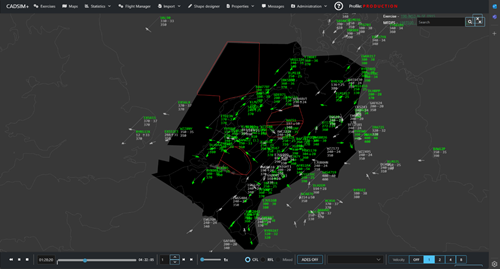
Figure 1 – An excerpt of CADSIM, the traffic manager web-based application
The first enabler of this shift has been the development of CADSIM, a web-based application for creating and maintaining simulator exercises that also contains a custom-made task load algorithm to help define the learning curve in the course design. CADSIM dramatically increases productivity - often tenfold - by allowing instructors and subject matter experts to build, adjust, and reuse exercises with far greater speed and precision than before. What once required complex coordination with technical teams can now be done directly by training staff, accelerating iteration and ensuring that simulation content keeps pace with operational needs to provide increased quality and higher success rate.
Three additional innovations stand out as central to MUAC’s modernisation: Automatic Speech Recognition, which enables realistic communication training without pseudo pilots; scoring, which aims to provide objective, competency-based performance metrics; and eye-tracking, which offers objective insights into situational awareness and cognitive processes.
Together, these technologies will allow deficiencies to be identified and adequate remedial actions to be planned at earlier stages, thus forming the core of a training environment that is more flexible, more intelligent, and far better aligned with the demands of contemporary air traffic control.
Automatic Speech Recognition: Bringing real world communication into multiple aspects of training
Communication sits at the core of air traffic control, and in the years following the pandemic MUAC significantly accelerated the development of an Automatic Speech Recognition (ASR) system capable of understanding ATC phraseology, extracting clearances, and interacting directly with the simulator.
ASR opened the door to remote and self-learning; allowing trainees to practise exercises without the need for a pseudo pilot or instructor. Upon receiving a clearance from the student, the system interprets and responds to it by making an adequate system input and reads-back via a text-to-speech model that mimics real “pilot” actions to enable realistic, interactive training from home or any remote location. This would not only preserve training continuity during periods of disruption but also expands access and flexibility long after normal operations resume.
The technology also increases training throughput. By automating pilot responses, ASR reduces the dependency on human resources and allows more exercises to run in parallel. Instructors could shift their attention from repetitive phraseology drills to higher value coaching and scenario-based guidance. At the same time, ASR brings a new level of consistency to training. It evaluates standard phraseology objectively, ensuring that trainees receive uniform feedback regardless of who is teaching or when the session takes place.
In essence, ASR transforms training from a resource intensive activity into a scalable, accessible, and highly reliable capability - one that continues to evolve as machine learning models are refined with operational data and real-world usage.
Competency Based Scoring: More objective, data driven assessment
As MUAC moved toward Competency Based Training and Assessment (CBTA) with its own Competency Based Assessment Scheme (CBAS) tool, it became increasingly clear that traditional assessment methods rooted largely in instructor observation were no longer sufficient for the level of consistency, transparency, and scalability the organisation required. To address this, a scoring engine prototype was developed to provide objective, traceable performance metrics which would inform the ATCO competencies.
The scoring engine evaluates a wide range of indicators. These data points are being mapped to some key ATCO competencies. By grounding assessment in observable, quantifiable indicators, the system supports the coaches to evaluate the trainees against the same standards, regardless of instructor.
Scoring can support several key use cases across the training journey. In self-learning, trainees could receive immediate, objective feedback to understand their own performance without waiting for instructor review. At the end of the simulator-assessed runs, the scoring engine can automatically populate the CBAS report with relevant metrics, reducing instructor workload and increasing the reliability of high stakes evaluations. Over time, the system also identifies behavioural patterns and emerging deficiencies, enabling targeted interventions and personalised training plans long before issues become critical.
At the end of the scoring validation process, we expect that scoring will become a cornerstone of MUAC’s modern training philosophy: more objective, data driven and tightly aligned with operational competencies.
Eye-tracking: A new window into situational awareness
Situational awareness is one of the most essential and historically one of the most difficult competencies to assess in air traffic control. Traditionally this assessment relies heavily on instructor observation, making it challenging to capture the subtleties of how trainees perceive, prioritise, and process information. Eye-tracking technology fundamentally changes this dynamic by providing quantitative insight into where trainees look, how they scan the traffic picture, and how effectively they distribute their attention.
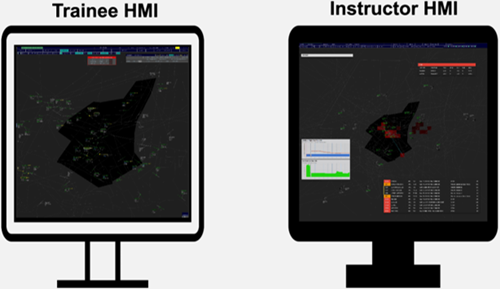
Figure 2 – A depiction of a working setup where the instructor's view is augmented by eye-tracking and scoring data
By analysing gaze patterns, eye-tracking may reveal whether trainees maintain an effective scan, whether they become fixated on non‑critical elements. This information gives instructors a far deeper understanding of trainees’ performance than was previously possible, supplementing subjective judgement with objective evidence.
The true power of eye-tracking emerges when it is integrated with scoring and debriefing tools. Gaze data is synchronised with simulator events and performance metrics, allowing instructors to replay scenarios with visual overlays that show exactly what the trainee was focusing on at critical moments. This creates a highly impactful learning experience: trainees can see not only what they did, but what they were paying attention to and where their blind spots were. It elevates situational awareness training from interpretive discussion to concrete, evidence-based insight.
Through this integration, eye-tracking becomes a vital component of MUAC’s modern training ecosystem, enhancing both assessment and learning by making the invisible visible.
A fully integrated ecosystem: MUAC’s Training Unit transformed
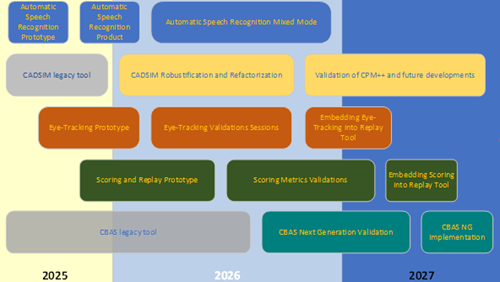
MUAC’s transformation reaches its full potential not through individual innovations, but through the way they now operate as a unified, end-to-end training ecosystem. Automatic Speech Recognition captures communication behaviour with precision, the scoring can inform performance, and eye-tracking reveals how trainees scan and prioritise information, while replay tools merge these data streams into rich, evidence-based debriefings. In addition to that, the new generation of the CBAS will use AI to prepopulate assessment reports with scoring metrics and transcribed instructor feedback, dramatically reducing administrative burden. The new ecosystem ties all services together into a seamless workflow that supports the entire training journey from early self-study to final operational assessment.
What began as an acceleration driven by the onset of the pandemic has evolved into a strategic advantage, building on a long-standing vision to modernise ATC training. Today, MUAC is positioned as one of Europe’s most advanced and data-driven training environments, at the forefront of innovation in ATC training. A key enabler of this progress is the uniquely close collaboration with in-house engineering teams, whose expertise and responsiveness allow operational and training ideas to be translated into practical solutions within very short timeframes.
The result is a future-ready training organisation built on improved efficiency, strengthened standardisation, and the systematic use of objective data, leading to more consistent and actionable feedback, an increased success rate for trainees, scalable training delivery even under disruption, better-prepared controllers, and an ecosystem that engineering teams can sustain and evolve with confidence.
This article originally appeared in the ATC Network Special Bulletin on Training, Simulation and Recruitment. You can read the full publication here:

.png)





.jpg)