EUROCAE Paves the Way for Alternative Technology Primary Radars
The leading European organization for the development of international aviation standards has published its Technical Specification for an Independent Non-Cooperative Surveillance (INCS) System.
EUROCAE, the European Organisation for Civil Aviation Equipment, is a body that draws together specialists from operators, air navigation service providers and suppliers to address challenges and standardize solutions for future airspace needs.
Working Group 103 was tasked to review the application of new technologies to the role of ATC primary surveillance as members faced issues of:
- Pressure on frequency allocation
- Escallating through life cost
- Radars vs windfarms
- ‘Not in my back yard’ protests
- Availability of alternate technologies
These could include, amongst others, continuous wave (CW) radar, wide area multi-lateration (WAM) networks, passive bi-static and passive multi-static solutions.
Each of these would take users and particularly procurement teams well out of their comfort zone, as none can be defined by traditional references to wave-length, azimuth accuracy, pulse characteristics and so on.
It is here that the working group came up with the inspired ‘equivalence’ idea of stating Performance Levels (PL) for 3 and 5 NM separation tied to the surveillance standard, a basic 1990s 2D S-band active rotating radar, as defined in Eurocontrol ESASSP. In simple terms, each INCS requirement and verification methodology is aligned to its ESASSP equivalent to allow a technology agnostic read across.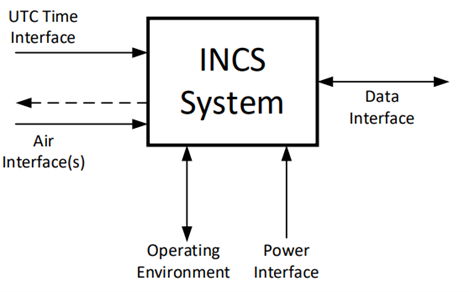
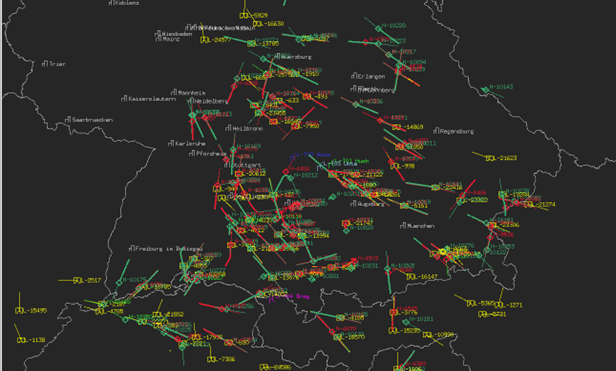
That the sensor is an INCS will be transparent to the user community, with data transfer, display interfaces and infrastructure following industry open standards. The real-world example below is non-cooperative surveillance of Southern Germany is colour coded for three INCS sensors.
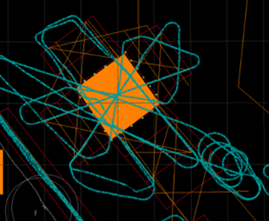
The level of reflection of broadcast transmissions by composite aircraft may be surprising to readers but the following two examples highlight the sensor capability against challenging targets, thermalling gliders and a trials aircraft low over a windfarm.
The former highlights a significant non-cooperative surveillance task, protection against controlled airspace ‘busts’ by overenthusiastic sports aviators. The accurate 3D high update rate of Twinvis greatly enhance controller situational awareness in deconfliction decisions.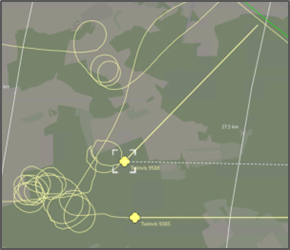
In its use of 3rd party transmitters Twinvis totally avoids the scourge of basic active radars, the huge reflection of that transmitted energy by wind turbines in the surveillance volume.
Trials over onshore and offshore wind farms show this novel surveillance technology is impervious to turbine clutter effects and does not require sophisticated signal processing techniques or lossy filtering techniques to deliver genuine windfarm mitigation.
As a bi-static INCS sensor Twinvis consists of:
- A half-height 19” electronics rack
- A mast, optional telescopic
- An antennae array
For multi-static INCS operations only additional sensor sets are required as each sensor is capable of being the cluster control unit.
Power, command inputs and data outputs are interfaced via the electronics rack, which is suitable for office, shelter or vehicle configurations. The sensor’s COTS electronics use 240 V or 110 V mains power. These environmental requirements can be fulfilled in the backyard or in an Air BnB ‘radar site’. Deployable configurations are operational in less than one hour.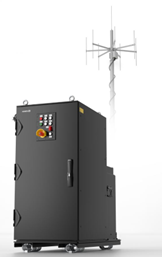
This sensor, from HENSOLDT, is a successful and combat proven bi-static and multi-static passive air defence radar called Twinvis, ‘Twice Invisible’, as it immune from electronic detection and silent from the aircraft’s perspective. An important benefit in ATC applications is the 1 s update rate.
The EUROCAE document will form the basis for the civil certification of Twinvis as an INCS that will offer ANSP a non-cooperative surveillance layer at a fraction of the cost and complexity of the ESASSP radars it is supposed to be equivalent to.
Its simplicity and low cost come from dispensing with the whole transmitting chain and rotating gear of an active ATC radar. Instead, it receives direct and rebound signals from multiple broadcast transmitters continuously and around the complete 360° azimuth.
It is the differences between these pairs of direct and rebound signals in time, doppler and arrival vector which are integrated to provide the air surveillance picture.
None of this can be defined by pre-INCS concepts but the 3D accuracy and 1 second refresh rate give a PL1 rating – 3 NM Separation for Approach and Terminal Area control, in support of the Cooperative surveillance layer.
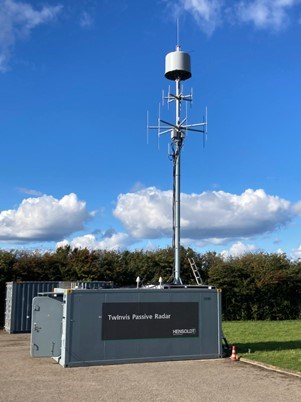
In addition to its participation in EUROCAE, HENSOLDT, is working closely with a number of ANSP to collectively broaden understanding and experience of passive radar as an ATC sensor. This process has helped greatly in informing the development of the EUROCAE INCS document while, in parallel, it is generating the evidence base that ATC certification rightly demands.
With this foundation, and together with a partnership agreement from a major European ANSP, Hensoldt can confidently forecast the civil certification of Twinvis as an INCS solution in 2026 and customer deliveries in 2027.
For comments and enquiries relating to the INCS document please contact Dr Stephan Meneghini, stephan.meneghini@hensoldt.net , or Karl Thompson, karl.thompson@hensoldt.net , regarding Twinvis.



.png)







.jpg)