PRISMA designates COMSOFTs modular system architecture incorporated in their ATM Automation System. It offers an advanced and powerful solution for ATC automation to be used in Area Control Centres, Approach Units and Tower applications. An open and modular architecture allows PRISMA to be easily tailored and integrated into different environments so as to meet all operational requirements. Advanced PRISMA components provide for smooth integration into customized systems.
 The PRISMA Controller Working Positions provide a clearly structured and integrated representation of the air situation, combining actual surveillance sensor data and planning information. The display shows each aircraft position, its identification and current course and heading, with static background information provided by multiple coloured maps of the airspace. The picture is enriched with coordination information, safety net alerts, and auxiliary information. Each CWP user can specify his individual preferences in a personal profile that can be retrieved from all working positions. Supporting optional screen content recording, the consoles data presentation is captured in video sequences. An export option makes such recorded data available for post-mortem analysis.
CWP characteristics:
Fully graphical user interface
Coloured maps
Personal user profiles
Integrated screen content recording (AVI, MPEG4)
The PRISMA Controller Working Positions provide a clearly structured and integrated representation of the air situation, combining actual surveillance sensor data and planning information. The display shows each aircraft position, its identification and current course and heading, with static background information provided by multiple coloured maps of the airspace. The picture is enriched with coordination information, safety net alerts, and auxiliary information. Each CWP user can specify his individual preferences in a personal profile that can be retrieved from all working positions. Supporting optional screen content recording, the consoles data presentation is captured in video sequences. An export option makes such recorded data available for post-mortem analysis.
CWP characteristics:
Fully graphical user interface
Coloured maps
Personal user profiles
Integrated screen content recording (AVI, MPEG4) 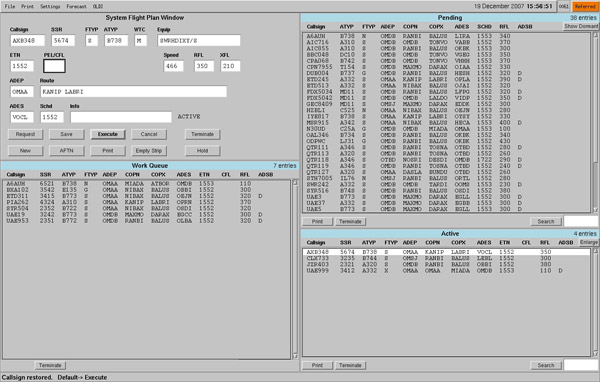 The PRISMA Assistant Working Position presents all flight plan information in a compact and well structured form. Data can be arranged and processed on a single screen, which accurately displays the status of flights. The assistant can so efficiently manage even high traffic loads.
AWP characteristics:
Single screen data management
Pre-emptive user inputs for fast data management
Interactive flight plan data management
The PRISMA Assistant Working Position presents all flight plan information in a compact and well structured form. Data can be arranged and processed on a single screen, which accurately displays the status of flights. The assistant can so efficiently manage even high traffic loads.
AWP characteristics:
Single screen data management
Pre-emptive user inputs for fast data management
Interactive flight plan data management 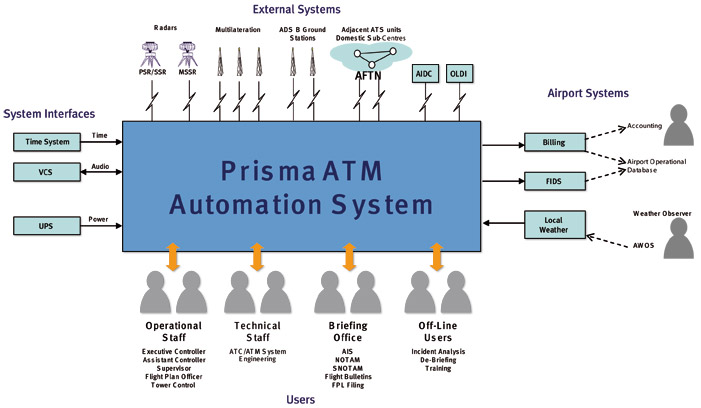 The PRISMA Safety Nets provide a crucial contribution to the safety of air traffic. Attracting the ATCO's attention to safety critical situations, PRISMA Safety Nets substantially support air traffic services. Powerful algorithms based on probabilistic methods implemented by PRISMA Safety Nets achieve best trade-offs between early safety alarms and the minimal number of nuisance alerts. In addition to predictive safety net functions, PRISMA includes situational safety nets that monitor aircrafts movements and their adherence to given clearances.
Safety Nets characteristics:
STCA, MSAW, and APW
RAM and CLAM
The PRISMA Safety Nets provide a crucial contribution to the safety of air traffic. Attracting the ATCO's attention to safety critical situations, PRISMA Safety Nets substantially support air traffic services. Powerful algorithms based on probabilistic methods implemented by PRISMA Safety Nets achieve best trade-offs between early safety alarms and the minimal number of nuisance alerts. In addition to predictive safety net functions, PRISMA includes situational safety nets that monitor aircrafts movements and their adherence to given clearances.
Safety Nets characteristics:
STCA, MSAW, and APW
RAM and CLAM 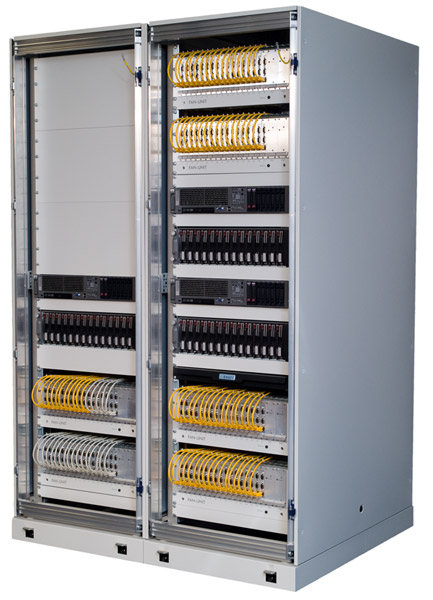 All PRISMA modules are available as stand-alone ATM solutions, which can be integrated into existing environments. Supporting open and adaptable interfaces, PRISMA modules combine outstanding performance with a high degree of flexibility and scalability. Stand-alone solutions are especially attractive for Air Traffic Service Providers who require gradual system upgrades and modernisation of a given environment. PRISMA stand-alone solutions can be as compact as single workstations for radar display or provide the backbone for ACC solutions.
  Apart from being a stand-alone ATM automation system, PRISMA can join existing CNS infrastructures. In fact PRISMA is able to receive surveillance data from other tracking systems and is perfectly suited to interact with ARTAS, the EUROCONTROL SDPS. The same applies to pre-processed flight plan information that can be received from external sources.
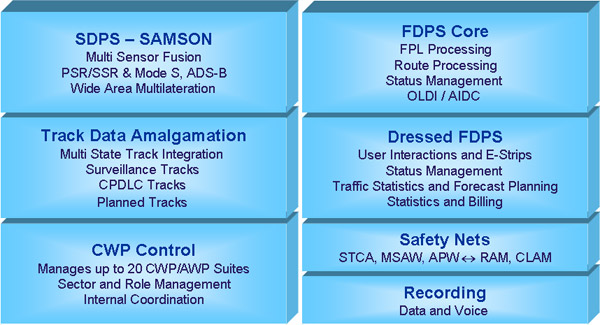
 The core of the PRISMA architecture is formed by an advanced Flight Plan Data Processing System and a sophisticated Surveillance Data Processing System. These can be easily supplemented by multiple components such as PRISMA modules for safety net functions, traffic statistics and billing information, traffic forecast and advanced recording and replay.
PRISMA features a variety of graphical user interfaces, each tailored for the needs of different individual users of the ATC system. The focal point for all operations is the ATCOs Controller Working Position, which integrates a real time depiction of the air situation with flight planning information. A multitude of efficiently accessible functions and clear representation support the ATCOs work.
Powerful integrated modules forming the ATM Automation System
Uncomplicated adaptability to Area Control Centres, Approach Units and Tower Applications
Automatic Flight Plan Data Processing featuring automatic silent sector coordination, dynamic flight profiles, and traffic forecast
State-of-the-art Multi-Sensor Surveillance Data Processing, supporting heterogeneous
sensor networks with PSR, SSR, Mode S, ADS-B and ADS-C sources
Complete set of ground-based Safety Net Functions
Data, voice and screen content Recording
PRISMAs Flight Plan Data Processing System manages the status of all flights that are under control at any time. PRISMA receives and automatically processes flight plan and coordination messages from AFTN networks and adjacent ATS units. All incoming information is assessed as to consistency and coherence. The PRISMA FDPS automatically extracts flight paths, calculates flight time profiles, and supports traffic prediction. The system uses an incremental online processing mechanism that guarantees fast responses to all human interactions with the system, as well as quick adaptation to sudden changes of the situation.
Hosted on fully redundant servers, the PRISMA FDPS provides highest availability. Consistent duplication of all major data sets, including the active flight data base, traffic statistics and dynamic profiles, as well as forecasts for sectors, waypoints and airports, ensures seamless and transparent switchover in the case of single-server failure.
FDPS characteristics:
Powerful redundant Flight Plan Data Processing for instantaneous responses
Fine-grained flight profile calculation
Traffic forecast and statistics
Collection of billing data
Internal and external coordination
Interfaces to AFTN, OLDI, AIDC
Processing of meteorological data
The PRISMA Multi Sensor Surveillance Data Processing System handles surveillance data from conventional radars - including primary, secondary and Mode S radars - as well as ADS-B, ADS-C and multilateration data. All sensor data is processed by state-of-the-art interacting multiple model tracking algorithms developing into a consolidated, real-time air situation picture.
SDPS characteristics:
Interacting multiple model tracking
Conventional PSR and (M)SSR support
Mode S radars
ADS-B
ADS-C/CPDLC
Multilateration cluster
The PRISMA Recording and Replay Module provides synchronous recording of data and, optionally audio, Furthermore the screen content of each individual workstation can be captured.
Recording and Replay characteristics:
Synchronous recording of data and audio, enabling most accurate reconstruction and assessment of any kind of air situation
Accurate recording of screen contents, showing the actual representation of information
Instant access to recorded information via internet browsers, permitting immediate investigations without the need of complex setups or media retrievals
PRISMA is designed and developed to meet the most stringent needs of mission critical systems rendering ATC services, and substantially contributes to the safety of air traffic. As a safety critical system PRISMA complies with international development standards that support ESARR conformant implementation. PRISMA conforms to ESARR 4 on system level and ESARR 6 for the software development, and substantially supports an ESARR 3 compliant safety process.






.jpg)




.png)