
Twenty years of Entry Point North: a conversation with Anne Kathrine Jensen Chief Executive Officer at Entry Point North
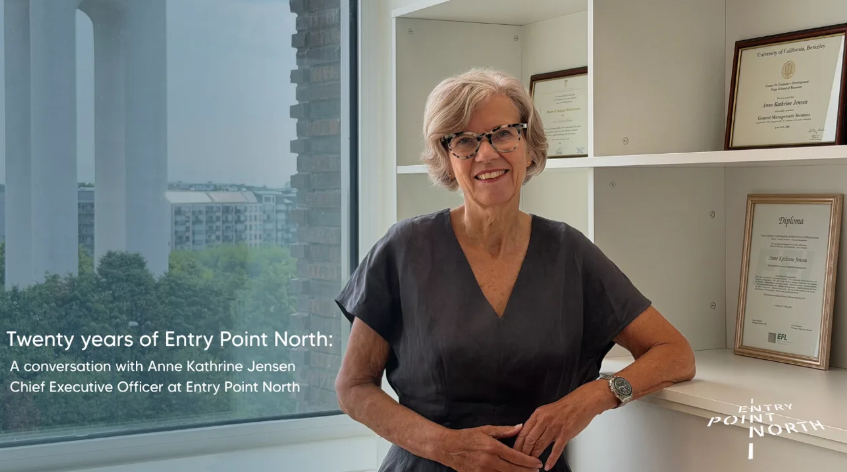
Twenty years says something on its own. But in Entry Point North’s case, it says more when told by someone who has been there from the start. Anne Kathrine Jensen became CEO in 2005 and has led the company through every major step since then. That gives her a rare view of how Entry Point North was built, how it changed, and what has mattered most along the way.
Her own path into the role began in training. She was working as an Air Traffic Controller in the Area Control Centre in Naviair and had long been interested in training. Later, as Head of Training in Naviair, she joined the project that would lead to a common Scandinavian academy. When that project phase ended and she earned her eMBA degree, she was asked to start Entry Point North and become its CEO.
In the beginning, the task was clear.
Three Scandinavian air navigation service providers (ANSPs), Naviair, LFV and Avinor, wanted one common academy in Sweden where students could be trained in the same way, to the same standard, regardless of which ANSP they would continue to. For Anne Kathrine, that was one of the most important things to build in the early years.
It also meant working across three different regulatory systems at the same time. Entry Point North needed approval in Denmark, Norway and Sweden while trying to build one shared training setup across all three countries. That made the start demanding. But the purpose was simple: better quality through one common academy, and lower cost by doing more together.
When Anne Kathrine looks back at the company’s history, she talks less about milestones and more about turning points.
The first came in 2008.
As air traffic fell during the financial downturn, demand for new controllers fell with it. For Entry Point North, that made one thing very clear: a company with only three customers and a limited scope would not be financially sustainable over time.
That changed the direction of the business. Entry Point North needed to become relevant to a broader customer base and be able to deliver more than it had in the beginning. Anne Kathrine describes that shift as deliberate. The company built a strategy, developed more services, strengthened its international workforce, and gradually broadened its customer base.
Growth took a different form
Another important step came when Entry Point North saw that growth would not only come from bringing customers to Sweden.
Some customers wanted training closer to home. Some also wanted to be part of delivering it themselves. That led to a different model.
Anne Kathrine points to Hungary as the first example. There, Entry Point North and HungaroControl created a joint venture, the first of its kind. Entry Point North contributed training expertise, material, simulators and exercises. HungaroControl contributed operational knowledge, students and practical instructors.
For her, that mattered because it showed that Entry Point North could grow through a win-win partnership, not only from one central academy.
The next turning point came with the pandemic.
When people could no longer meet in person, it became clear that training needed to work differently. Anne Kathrine describes that period as the first real step towards becoming much more digitalised, not only in how people met, but in how training itself could be delivered.
Since then, she says, this way of delivering training has continued to develop. She points to flexibility for customers and participants, better ways to follow student development, and future possibilities in translation, training data, and AI as support in online training.
When asked what has made customers continue to trust Entry Point North through all these changes, Anne Kathrine does not begin with systems or simulators.
She begins with people.
In her view, the reason is the staff. Training is not something they do on the other hand. It is what they have chosen to do. Many come from the industry itself. They understand the customer’s reality, and they care about getting the training right.
That, she says, is what customers tell us they feel.
It is also what she hopes customers take away from working with Entry Point North: that the company understands their needs and makes a real effort to deliver what fits them. For her, that understanding is built into contact, in the meetings, and in the conversation.
Anne Kathrine is very clear on this point.
She says one of the great personal privileges of these twenty years has been the chance to build and lead a company in a way that reflects who she is, what she believes in, and the values she stands for. For her, leadership has to be genuine. If people are going to trust a leader, the values spoken about at work have to be the values actually lived by.
She does not feel that this has changed over time. The situation has changed. Entry Point North has had to adapt many times. But her own view of values and leadership has stayed the same. As she puts it, she is the same person at work as she is at home. For her, that consistency is an important part of leading in a way that people can trust.
One of the most striking things Anne Kathrine says is that she never had a detailed plan for taking Entry Point North exactly where it is today.
What she had instead was an open mind and a habit of looking outward. What was happening in aviation, around customers, in geopolitics and in the wider world. For her, that mattered more than trying to have all the answers from the beginning.
That is also what she hopes remains true in the years ahead: that Entry Point North continues to understand where the opportunities are and is brave enough to pursue them.
In that sense, her story says something important about the company as well. Twenty years on, Entry Point North grew by paying attention, adapting early and staying close to the people and realities that shape the industry.



.jpg)


.png)
Comments
There are no comments yet for this item
Join the discussion