
NATS unveils digital-twin platform for air traffic controller recruitment
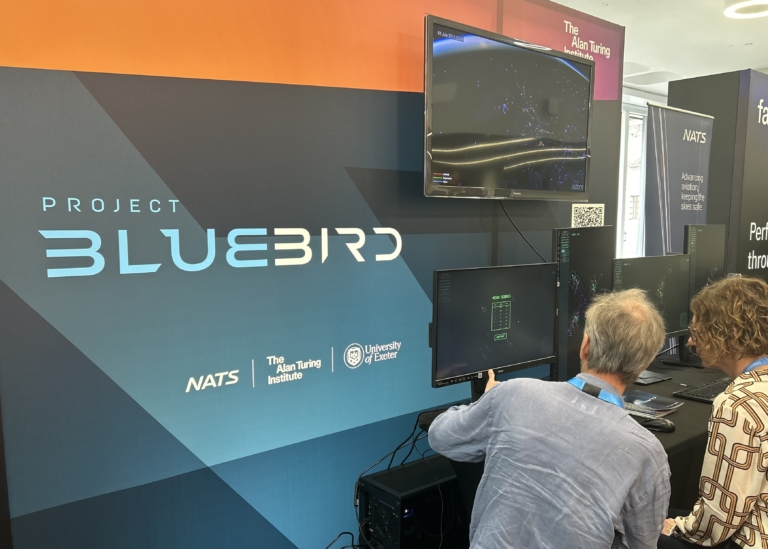
NATS has announced a major milestone in its advanced technology research programme with the deployment of BLADE – a secure digital-twin powered platform to enhance how the company recruits and trains the next generation of air traffic controllers.
Stemming from NATS’ pioneering research within Project Bluebird, BLADE leverages new generation technology for real-world operational challenges. The platform was successfully used during the Autumn 2025 trainee air traffic controller assessments, marking the first time NATS’ digital twin technology has been used in a live recruitment process.
BLADE represents a step-change in how we identify and onboard talent for complex operational roles,” said Paul Hosmer, Head of R&D at NATS. “It enhances the candidate experience while giving us a deeper understanding of individual potential. Our people are at the heart of what we do, and BLADE shows how innovation can help us find and develop the best talent for the future of UK aviation.”
Candidates were immersed in realistic air traffic control scenarios and evaluated against key performance metrics including safety, efficiency and task completion. The platform also enabled recruiters to assess cognitive and behavioural skills such as situational awareness, communication and problem-solving in a realistic ATM environment.
Rooted in competency-based assessment, BLADE aligns baseline performance with training potential to support career-long development. Future enhancements are expected to include AI-assisted insights and predictive analytics, improving both the accuracy and consistency of candidate evaluation. The outcomes of this innovative approach will become clearer once this first group of candidates have progressed through the training college and started in an operational role.
“Our team worked with HR and Talent Services and the Training College to configure the Bluebird digital twin and make it securely accessible to candidates anywhere”, said Frankie Hui, Software Engineer at NATS. “It was a challenging but rewarding journey, and it’s fantastic to see the twin now helping to recruit our newest generation of ATCOs”.
BLADE builds on the research carried out through Project Bluebird, a collaboration between NATS, The Alan Turing Institute and the University of Exeter. Bluebird created a digital twin of UK airspace to model and test complex air traffic scenarios, and to develop AI tools that can safely assist human controllers. That same technology now enables BLADE to generate rapid-turnaround, high-fidelity, realistic assessment environments for trainee controllers.
“The new TATC recruitment tool is a brilliant addition to the process” says Jenny Ludford, Head of the NATS Training College. ”It allows us to test for important technical skills whilst also providing candidates with a preview of what to expect during training, and its receiving great feedback from ATCO assessors and candidates alike. We are excited to see further developments, and to track how candidates perform through their training next year.”
As NATS continues to lead the responsible development of trustworthy AI in safety-critical environments, BLADE demonstrates how cutting-edge research can deliver real-world benefits – enhancing recruitment, reducing training time and strengthening the pipeline of future air traffic controllers.
.jpg)


.png)








Comments
There are no comments yet for this item
Join the discussion