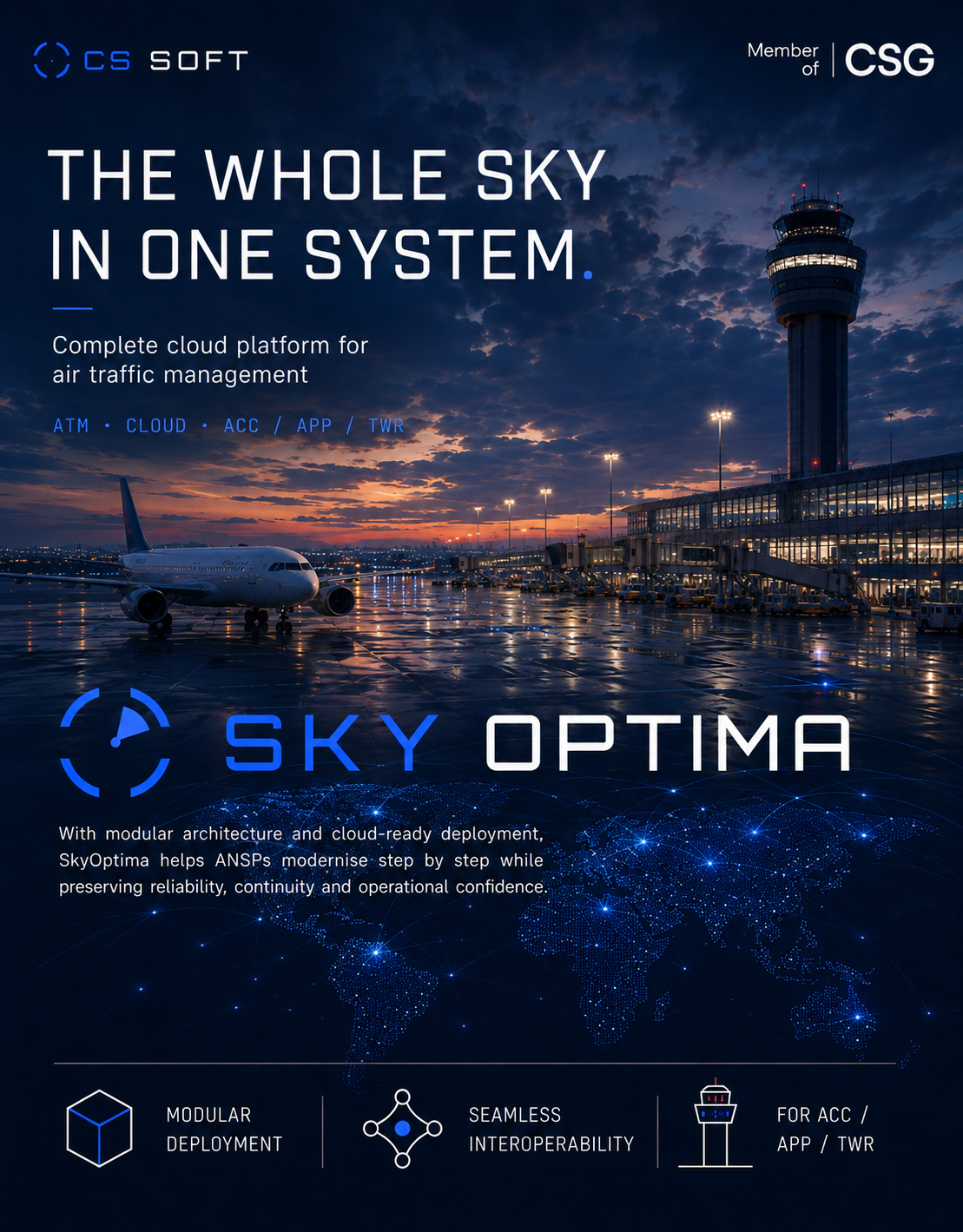
Controllers need an up-to-date picture of the traffic they are managing. Engineers investigating a datalink problem need a record they can work back through. Prague-based CS SOFT, Member of CSG, develops software for both jobs. SkyOptima brings flight plans and surveillance tracks together for controllers, while PAGODA helps engineers investigate air–ground datalink performance.
A controller sends a clearance over datalink. By the time the reply comes back, the aircraft has moved on and its track is still updating on the display. The engineer reviewing the exchange later has a different question. Did other flights on the same frequency experience a similar delay? The answer can help the team decide where to look first.
From Prague to international air traffic operations
CS SOFT, Member of CSG, has worked in air traffic management (ATM) since 1988. The company develops operational ATM systems, flight data processing software, air traffic control simulators and specialist monitoring tools, with deployments across four continents.
For Air Navigation Services of the Czech Republic, the company supplied a backup flight data processing system. At Kaunas International Airport in Lithuania, its ALS system supports tower and approach control and provides backup for area control. The company also supplied an ALS ATM system for Sentani Airport in Indonesia.
The Czech and Lithuanian projects show how the scope of an ATM delivery can vary. At an established control centre, the priority may be to back up a particular processing function. At an airport, contingency can be part of an installation that also supports tower and approach operations. That range matters to an air navigation service provider (ANSP) deciding whether to modernise one part of its operation or replace a system serving several control positions.
Following a delayed reply with PAGODA
A dashboard can show that a smaller share of controller–pilot data link communications (CPDLC) exchanges is being completed within the expected time. To see what changed, an engineer needs to look at the individual messages behind that figure. PAGODA links the datalink message history with radio and surveillance data. The engineer can follow an exchange in sequence, see where the aircraft was and check the radio link conditions when the messages were sent.
The team can compare exchanges by frequency, ground station, communications service provider or time period. If delayed replies cluster around one ground station, the team has a specific part of the network to examine. If they occur across several frequencies, engineers can check what else the affected flights have in common, such as the service provider or the time of day.
PAGODA also tracks indicators such as transaction continuity and provider abort rates. Historical data helps engineers establish whether a change was confined to one shift or has been recurring over a longer period. They can then return to the flights and messages involved, including the exchange that first drew their attention.
Building the controller’s traffic picture with SkyOptima
Radar and ADS-B can both report the position of the same aircraft. SkyOptima combines those surveillance reports into a track and correlates it with the flight plan. At the working position, the controller can see the aircraft’s current position alongside its flight identity and planned route. The platform also supports coordination between control positions and provides safety alerts.
SkyOptima can be configured for tower, approach and area control. An approach unit may need surveillance processing and working positions configured for its airspace. An area control centre may also need more extensive flight data processing and coordination with neighbouring centres. The platform’s service-oriented architecture supports primary and contingency operations, with on-premises, cloud and hybrid deployment options.
During a phased upgrade, an ANSP may need to keep existing radar feeds, flight data systems and coordination links in service while bringing new functions online. SkyOptima’s open architecture and standardised interfaces help providers connect systems from different suppliers and reduce dependence on a single vendor. Its readiness for System Wide Information Management (SWIM) also gives ANSPs a basis for introducing new information exchange services over time.
SkyOptima includes an embedded ATC Radar Simulator for training and testing. It can replicate the operational controller interface, so teams can rehearse unusual traffic scenarios or test a configuration change in a familiar environment before introducing it into live operations. After a shift, recording and replay let a team reconstruct a traffic situation and review the sequence of events.




.jpg)


.png)